

Choosing the wrong pump in oil and gas service is expensive. A twin screw pump specified without adequate gas-handling capacity will cavitate on a multiphase wellstream. A three screw pump running below its minimum viscosity will wear prematurely on low-lubricity products. A progressive cavity pump without the right elastomer will fail on sour crude within weeks.
We manufacture screw pumps at CTP and spend every working day matching pump types to process conditions. This guide distils what we have learned across crude oil gathering, multiphase production, refinery transfer and associated gas recovery — the four applications that account for the majority of screw pump installations in the oil and gas industry.
By the end you will know which screw pump type fits which application, what data you need to specify it, and where each technology reaches its limits.
Why Screw Pumps Dominate Oil & Gas Applications
Screw pumps are positive-displacement machines. Unlike centrifugal pumps, their flow rate is proportional to speed and largely independent of discharge pressure. This gives them three properties that matter in oil and gas:
- High-viscosity capability. Screw pumps handle fluids from thin naphtha (2 cSt) to heavy crude exceeding 100,000 cSt — without the efficiency collapse that centrifugal pumps suffer as viscosity rises.
- Low pulsation and low shear. The progressive cavity action of intermeshing screws moves fluid axially with minimal turbulence. This matters for emulsion stability, for keeping associated gas dissolved, and for protecting pipeline coatings.
- Self-priming and dry-run tolerance. Twin screw and progressive cavity pumps can self-prime and tolerate brief dry running — a practical advantage at tank farms and well sites where suction conditions vary.
Screw pumps are not universal. For high-flow, low-viscosity, clean-water duties (sea-water cooling, boiler feed), centrifugal pumps remain the better choice. For very high-pressure, low-flow metering, reciprocating pumps win. The screw pump’s sweet spot is moderate pressure (up to 100 bar standard, higher with special designs), moderate-to-high viscosity, and applications where gentle, continuous flow matters.
Four Key Applications and Their Pump Requirements
1. Crude Oil Gathering & Transfer
At the wellhead and at gathering manifolds, crude oil arrives with variable water cut, entrained gas, and sometimes sand. The fluid is high-viscosity — especially heavy and extra-heavy crudes — and the flow rate must track well production as it declines over the field’s life.
Twin screw pumps are the standard choice here. Their intermeshing screw rotors create sealed chambers that progress from suction to discharge, handling gas void fractions up to 80% without losing prime. The W and HPW series are designed specifically for high-pressure, high-viscosity crude duties, with throughputs from 1 to 2,000 m³/h and working pressures to 100 bar.
Key selection data: crude viscosity at operating temperature (request a viscosity-temperature curve from your reservoir engineer), maximum gas void fraction, sand content (hardness and particle size), and ambient temperature range.
2. Multiphase Production & Associated Gas Recovery
Multiphase pumping — moving oil, gas and water as a mixed stream without separation — eliminates the need for offshore separation platforms and subsea separators. The pump must handle gas void fractions from 0 to 95%+ without surging, and cope with rapid changes in fluid composition as the well transitions between slug flow and annular flow regimes.
Twin screw pumps in the HW configuration are the workhorse for multiphase duties. The screw geometry tolerates high GVF while maintaining stable flow, and the pump’s self-priming capability handles the suction conditions typical of remote wellheads.
Associated gas recovery is a related application gaining urgency. The World Bank estimates that over 140 billion cubic metres of associated gas are flared globally each year. In southern Iraq — where CTP will exhibit at Iraq Oil & Gas 2026 — gas capture projects are accelerating under the Basra Gas Company framework. On the marine and offshore side, IMO MARPOL Annex VI regulations further tighten limits on volatile organic compound emissions from crude oil tankers, making gas recovery pumps a compliance requirement rather than an optional upgrade. Screw pumps serving these installations must handle wet gas with condensate carryover and tolerate H₂S concentrations typical of sour gas fields.
Key selection data: gas-to-liquid ratio range, fluid composition (especially H₂S and CO₂ content for material selection), ambient temperature extremes, and required discharge pressure for the gathering pipeline.
3. Refinery & Product Transfer
Inside refineries and at tank farm loading racks, the fluid changes character completely. Diesel, gasoline, jet fuel and naphtha are low-viscosity (1-5 cSt), clean products where pump selection prioritises flow stability, vapour control and compatibility with pipeline specifications.
Three screw pumps — with one power rotor and two idle rotors — are the standard for these duties. The SN and SM series handle clean petroleum products at flow rates up to 1,200 m³/h with extremely low pulsation. The three-screw geometry produces a continuous, non-pulsating axial flow that protects pipeline coatings and maintains accurate metering at loading arms.
Typical applications include tank farm loading and unloading, pipeline booster stations, fuel oil circulation in refinery heaters, and lube oil transfer. For marine fuel oil transfer specifically, see our dedicated guide on marine fuel oil transfer pump selection.
Key selection data: product viscosity at pumping temperature, vapour pressure (for NPSH calculation), required flow accuracy for custody transfer, and any product-changeover frequency that affects seal selection.
4. Oily Waste, Sludge & Solids Handling
Oil and gas facilities generate oily sludge from tank bottoms, API separators and DAF units. This material is high-viscosity, often contains abrasive solids (sand, corrosion products, precipitated asphaltenes), and varies widely in composition batch to batch.
Progressive cavity pumps (eccentric helical rotor pumps) handle these conditions because of their large, open pumping chambers and the availability of wear-resistant elastomer stators. The G, EH and ER series can pass solids up to 30 mm diameter and handle viscosities above 100,000 cSt with the right rotor-stator geometry.
Key selection data: solids content and particle size distribution, sludge viscosity (request a rheology curve if available), temperature, and whether the stator elastomer must resist H₂S, aromatics or high-temperature degradation.
Twin Screw vs Three Screw vs Progressive Cavity — How to Choose
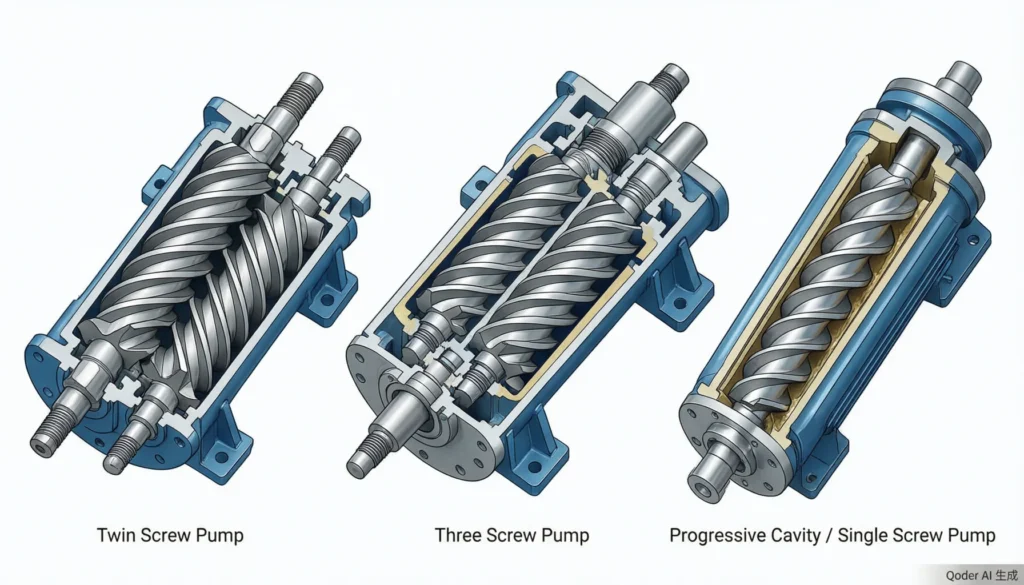
| Parameter | Twin Screw | Three Screw | Progressive Cavity |
|---|---|---|---|
| Viscosity range | 2 – 100,000+ cSt | 2 – 50,000 cSt | 1 – 500,000+ cSt |
| Flow rate | 1 – 2,000 m³/h | 0.5 – 1,200 m³/h | 0.1 – 500 m³/h |
| Max. pressure | 100 bar (standard) | 40 bar (standard) | 48 bar (single stage) |
| Gas handling (GVF) | Up to 80–95% | Low (needs dissolved gas <5%) | Low–moderate |
| Solids tolerance | Fine particles only | Clean fluids only | Up to 30 mm particles |
| Self-priming | Yes | Yes (with flooded suction preferred) | Yes |
| Pulsation level | Low | Very low (near-zero) | Low–moderate |
| Typical oil & gas duty | Crude, multiphase, associated gas | Refinery products, lube oil, fuel oil | Sludge, oily waste, dosing |
Decision shortcut: If the fluid contains significant gas or is abrasive crude, start with twin screw. If it is a clean, low-to-medium viscosity petroleum product, start with three screw. If it contains solids or is extremely viscous sludge, start with progressive cavity.
Five Selection Factors You Must Define Before Choosing
Regardless of pump type, these five parameters determine whether the selection will perform in the field:
1. Viscosity & Temperature
Viscosity is the single most important selection parameter for screw pumps. Always specify viscosity at the pumping temperature — not at ambient. Crude oil at 5°C may be 50,000 cSt; the same crude heated to 60°C drops below 500 cSt. If the process involves heating (common for heavy crudes and fuel oil), the pump must be sized for the cold-start viscosity at startup, not the running viscosity.
2. Flow Rate & Pressure
Define both the normal and maximum required flow rates. Screw pumps are speed-controlled, so oversizing the pump and throttling with a VFD is acceptable — but the pump’s maximum pressure rating must exceed the system back-pressure at all operating points, including pipeline block-in conditions.
3. Gas Content (Gas Void Fraction)
If the fluid contains free gas, this alone may dictate the pump type. Three screw pumps cannot handle significant free gas — the gas breaks the hydraulic seal between screws and causes flow instability. Twin screw pumps are specifically designed for gas-liquid mixtures and are the only screw type suitable for multiphase wellstreams with GVF above 10-15%.
4. Corrosiveness & Material Selection
Sour crude (containing H₂S) and sour gas services require materials resistant to sulfide stress cracking. Per the API 676 standard, screws in sour service are typically specified in through-hardened alloy steels meeting NACE MR0175 / ISO 15156 requirements. Seals and elastomers must also be compatible — FKM (Viton) for moderate H₂S, FFKM for severe conditions.
5. Classification & Standards
Oil and gas installations may require compliance with API 676 (screw pumps), ATEX/IECEx (explosive atmospheres), or classification society rules (DNV, ABS, Lloyd’s Register for offshore installations). Confirm the required certifications before specifying — they affect material traceability, documentation and testing scope.
Replacing an Existing Pump? What Nameplate Data Matters
Most screw pump enquiries we receive are replacements for pumps that have reached end-of-life or no longer match the process. If you are replacing an existing unit, the following nameplate and operating data will let us match or improve on the original selection:
- Original pump type, manufacturer and model number
- Fluid handled (and any changes since original installation)
- Viscosity at operating temperature
- Required flow rate and discharge pressure
- Operating temperature range (minimum and maximum)
- Running hours and failure mode (wear, seal leak, corrosion)
Send this data through our pump selection assistance form and our engineering team will return a recommendation — typically within 48 hours for standard duties.
Frequently Asked Questions
What type of screw pump is best for crude oil?
Twin screw pumps are the standard for crude oil duties because they handle variable viscosity, entrained gas and fine solids. For light, clean crude with no gas content, three screw pumps can also be used, but twin screw offers more operating margin.
Can twin screw pumps handle gas-liquid mixtures?
Yes — this is one of their defining advantages. Twin screw pumps handle gas void fractions up to 80-95% depending on the specific design, making them suitable for multiphase wellstreams without upstream separation.
What is the maximum viscosity a screw pump can handle?
Progressive cavity pumps can handle viscosities exceeding 500,000 cSt with the right rotor-stator geometry and drive power. Twin screw pumps typically handle up to 100,000 cSt. Above these ranges, special designs or pre-heating may be necessary.
How do I select materials for sour crude service?
Sour service (H₂S present) requires materials compliant with NACE MR0175 / ISO 15156. Screws and shafts are typically through-hardened alloy steels; seals use FKM or FFKM elastomers; casings may require corrosion-resistant overlays. Always confirm the H₂S partial pressure and pH with your materials engineer.
What is the difference between a twin screw and three screw pump?
A twin screw pump has two intermeshing rotors (both driven via timing gears) and creates pumping chambers between the screws and the housing. A three screw pump has one central power rotor driving two idle rotors, with the fluid progressing axially through the inter-rotor chambers. Twin screw handles gas and abrasives better; three screw delivers smoother flow on clean fluids and is typically quieter.
Bring Your Process Data to Our Engineering Team
Whether you are specifying a new installation or replacing an existing pump, CTP’s engineering team reviews your duty conditions and recommends the right pump type and configuration. No generic catalogue selection — we match the pump to your fluid, your pressures and your site conditions.
Data sources: CTP Pumps screw pump selection manuals (twin screw, three screw, eccentric helical rotor series); API 676 — Rotary Positive Displacement Pumps; World Bank Global Gas Flaring Reduction data (2025); CTP marine centrifugal pump selection manual, p. 68 (vessel application tables).
About CTP Pumps: CTP is a screw pump manufacturer based in China, supplying twin screw, three screw and progressive cavity pumps for oil & gas, marine and industrial applications. Visit our homepage or browse the oil and gas industry page for more.