
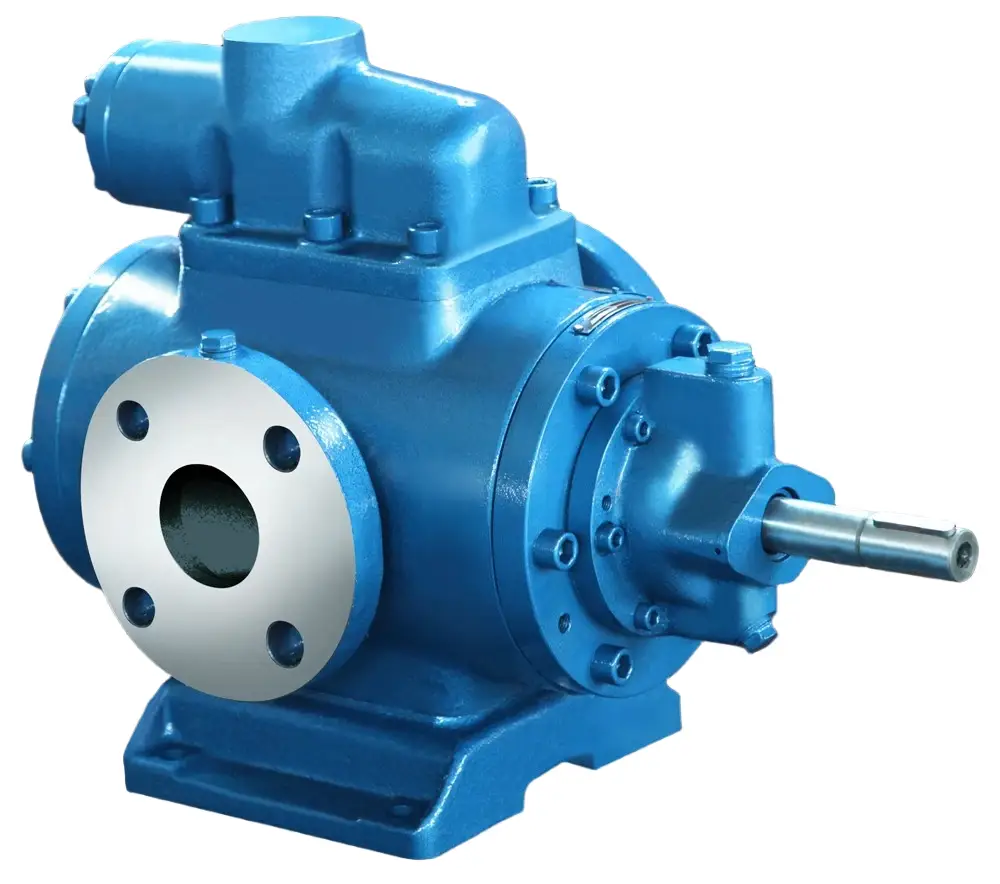
Short answer: to replace a three screw pump, match the duty and the installation, not the model name. Before ordering, confirm nine things: that a three screw pump is still the right type for the liquid; the flow at the required discharge pressure and speed; the full viscosity range; the temperature and heating; the flange, footprint and shaft height; the direction of rotation and the motor; the relief valve setting; the shaft seal and materials; and the documents the vessel or plant needs. Send nameplate photos, the existing drawing or measured dimensions, and the operating data. The replacement can then be selected for the actual service.
This guide is for marine engineers, ship repair yards and plant maintenance teams replacing a three screw (triple screw) pump on fuel oil, heavy fuel oil, lube oil or hydraulic oil duty. It covers complete pumps and pump sets. For how the pump works, see the three screw pump working principle.
Three screw pump replacement checklist
| Check | What to compare | Warning sign in an enquiry |
|---|---|---|
| 1. Pump type | Liquid, solids, lubricity, lowest viscosity | The old pump failed early and nobody knows why |
| 2. Duty point | Flow at the required discharge pressure, at the rated speed | Only flow, or only motor kW, is given |
| 3. Viscosity range | Lowest viscosity at highest temperature, highest at cold start | One viscosity value for a pump that sees HFO and gas oil |
| 4. Temperature | Normal and maximum liquid temperature, tank heating | Temperature missing for heated fuel |
| 5. Mechanical fit | Flange standard and rating, port positions, foot, shaft height, footprint | Nominal pipe size treated as proof of fit |
| 6. Rotation and motor | Direction of rotation, coupling, voltage, frequency, speed | A 50 Hz rating used for a 60 Hz ship |
| 7. Relief valve | Set pressure, built-in or system valve, motor margin | Set pressure unknown or above motor capacity |
| 8. Seal and materials | Seal type, materials for the liquid and temperature | “Same as existing” with no description |
| 9. Documents | Classification society, drawings, tests, certificates | Approvals discussed only after the order |
1. Confirm that a three screw pump is still the right type
A like-for-like replacement repeats the original design, including its weaknesses. Before matching dimensions, ask why the old pump is being replaced. Normal wear after many years of service is one answer. Repeated failures are another, and they often point to the liquid or the system rather than the pump.
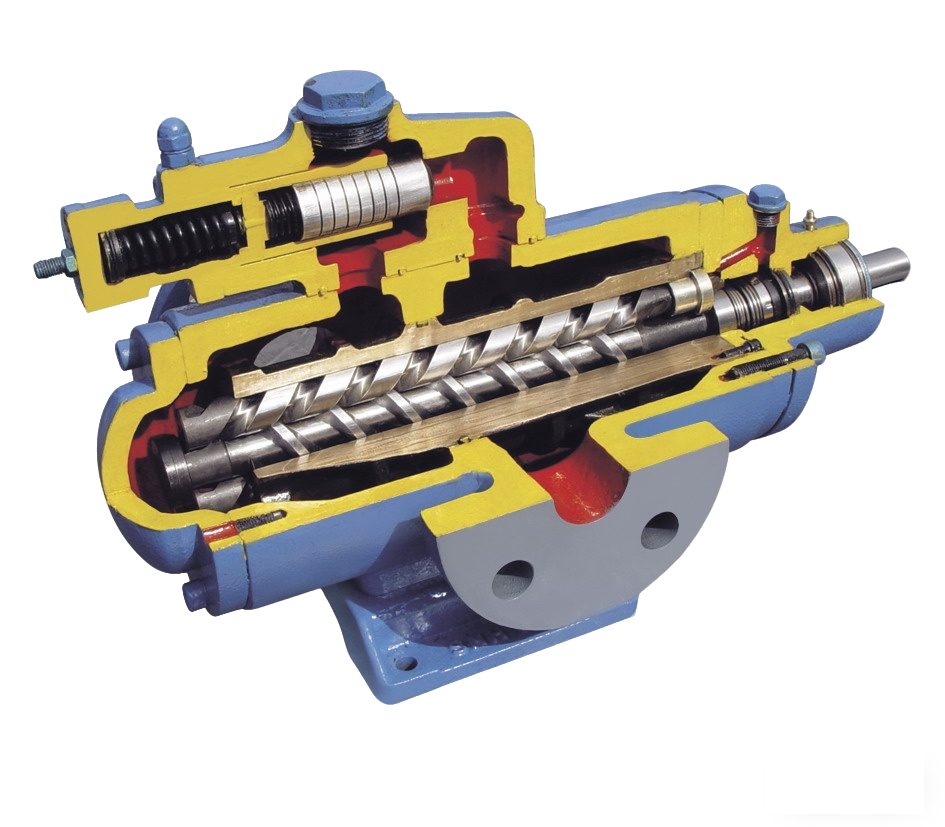
A three screw pump runs on a film of the pumped liquid between the screws and the liner. It suits clean liquids that lubricate, such as lube oil and hydraulic oil. It also handles poorer-lubricity liquids such as light and heavy fuel oil when the right series and rating are chosen. It does not suit:
- Solids and abrasives. Hard particles damage the close clearances. Check the suction strainer and the cleanliness of the tank. For sludge or high-solids liquids, a single screw (eccentric helical rotor) pump is the usual choice.
- Non-lubricating liquids or liquids with impurities. A twin screw pump has timing gears in a separate oil-lubricated gearbox, so the screws do not depend on the pumped liquid for lubrication.
- Dry running. Loss of suction, an empty tank or air in the line destroys the lubricating film. If the failure history shows noise, loss of pressure or worn screws, work through the three screw pump troubleshooting guide before ordering.
2. Match the duty point, not the motor rating
A three screw pump is a positive displacement pump. Flow is roughly proportional to speed and changes little with discharge pressure. The difference is internal slip back through the clearances, which rises with pressure and falls as viscosity increases. So the replacement must be selected for a specific combination: flow at a stated discharge pressure, speed and viscosity.
Take the existing data from the pump nameplate and the system design, and state them together, for example “20 m³/h at 0.6 MPa discharge, 1,450 rpm, 15 cSt”. This is an illustrative enquiry, not a CTP model rating. Two pumps with the same motor power can have very different flow at the same pressure.
Speed matters more than it looks. If the existing pump runs at 1,450 rpm on a 50 Hz supply and the new pump is quoted at 1,750 rpm for 60 Hz, the flow and absorbed power are different. Ask for the selection at the speed the motor will actually run.
3. State the full viscosity range, from cold HFO to distillate
Viscosity affects a screw pump more than any other liquid property. Residual fuels are specified by maximum viscosity at 50 °C; under ISO 8217, RMG 380 is limited to 380 mm²/s. In a tank that is only partly heated, the fuel reaching the pump can be much thicker. Distillates such as DMA marine gas oil are only 2.0–6.0 mm²/s at 40 °C. Many ships now switch between heavy fuel oil, very low sulphur fuel oil and gas oil, so one pump may see the whole range.
- The high end (cold start) sets the motor power and the suction conditions.
- The low end (warm distillate) increases slip and reduces lubrication. CTP three screw pump ratings start at 3 cSt for the SN, SM and 3G series. If the lightest liquid can fall below that, say so in the enquiry.
Give both ends: the lowest viscosity at the highest temperature, and the highest viscosity at the lowest temperature. The fuel oil transfer pump selection guide explains how each end affects sizing.
4. Check temperature and heating
Give the normal and maximum liquid temperature, and whether the tank and suction line are heated or traced. Temperature decides the viscosity at the pump, and also the seal and material choice. In the CTP range, the SN series is rated up to 250 °C; SM, 3G, SPF and SNHG up to 150 °C; and SZ and S3F up to 80 °C. Heated heavy fuel oil and asphalt duties need the temperature stated before a series can be proposed.
5. Verify the mechanical fit with a drawing
Use a general arrangement drawing of the existing pump, or a measured sketch, to compare the installation. A catalogue photo is not enough. Check:
- Flanges: standard, nominal size, pressure rating and bolt pattern for suction and discharge.
- Port positions: where suction and discharge sit relative to the foot and the shaft, seen from the drive end.
- Mounting: horizontal or vertical, foot or flange mounted, shaft centre height, foundation bolt positions and footprint.
- Space: room to remove the coupling, seal and screw set, and lifting access.
Small differences can often be resolved without changing the pipework. On CTP three screw pumps the pump case can be rotated through 180° to suit the pipe layout, and the pump has a flexible foot. The liner and screw set can be removed without disconnecting the suction and discharge pipes, which helps when access is tight. Any adapter, spacer or baseplate change should still be listed in the quotation. If the requirement is “no pipework modification”, write that in the enquiry.
6. Confirm the direction of rotation, coupling and motor
A screw pump moves liquid in one direction only, so the direction of rotation must match the suction and discharge sides. State it as seen from a defined end, normally the drive end. If the replacement uses the existing motor, also give the motor frame, shaft diameter, coupling type, power and speed, and ask for confirmation that the motor covers the new pump at the worst case. The worst case is cold-start viscosity combined with the relief valve set pressure, not the normal working point.
For a complete pump set, copy the vessel or plant electrical data: voltage, frequency, phase, enclosure and starting method. Delivery country is not a reliable guide to the supply on board.
7. Set the relief valve correctly
A positive displacement pump working against a closed valve builds pressure until something fails, so relief protection is essential. CTP three screw pumps have a built-in relief valve. It protects the pump; it is not meant to control flow, and running for long periods with the valve lifting heats the liquid.
Give the existing set pressure and the maximum working pressure. The set pressure must sit above the working pressure and within the motor’s capacity. Class rules or the piping design may also require a separate system relief valve; confirm whether the built-in valve is enough for your installation.
8. Describe the shaft seal and materials
“Same as existing” is not a specification. State the current seal type (mechanical seal or packing), any leakage history, and the liquid, temperature and pressure the seal must handle. Ask the quotation to state the seal arrangement and the main materials of the casing, liner and screws for your liquid. Seal and material choices are confirmed against the operating conditions for each order.
9. Agree the documents before you order
For ships, name the classification society and any owner or yard specification at the enquiry stage. Ask which drawings, test records and certificates are included, which are quoted separately, and what needs approval before manufacture. A general certificate list from a supplier is not the same as confirmation for a particular pump and vessel.
Copy this into your replacement enquiry
Mark anything you do not have as “not available”. The engineer can then see what still needs measuring or confirming.
- Existing pump: maker, model, serial number, photos of the pump and motor nameplates, and a photo of the installation.
- Service: system (fuel transfer, fuel supply, lube oil, hydraulic), liquid and fuel grades.
- Duty: flow at the required discharge pressure, suction condition, speed.
- Viscosity and temperature: both ends of the range, and tank or line heating.
- Installation: drawing or measured sketch, flange standard and rating, port positions, mounting and shaft height.
- Drive: rotation direction, reuse of the existing motor or new set, electrical supply.
- Protection: relief valve set pressure, existing seal type.
- Documents and delivery: classification society, certificates, delivery port or site, and the date needed.
CTP three screw pump series for replacement duties
The CTP range covers most fuel, lube and hydraulic oil duties. Values are the upper limits of each series and do not occur together.
| Series | Typical replacement duty | Max flow (m³/h) | Max pressure (MPa) | Max temp. (°C) | Viscosity (cSt) |
|---|---|---|---|---|---|
| SN | Fuel oil transfer and supply, lube oil | 318 | 4.0 | 250 | 3–7,000 |
| 3G | Wide-range lube, fuel and hydraulic | 575 | 10.0 | 150 | 3–760 |
| SM | High-pressure lube, fuel and process oil | 200 | 10.0 | 150 | 3–7,000 |
| SZ | Vertical, large-flow low-pressure fuel and oil transfer | 550 | 1.6 | 80 | 3–760 |
| SPF | High-viscosity fuel, heavy oil and asphalt | 6.7 | 4.0 | 150 | 3–760 |
| SD | Ultra-high-pressure hydraulic | 75 | 21.0 | 150 | 3–760 |
The full range, including SNHG, S3F, SL, SE and SF, is on the three screw pump page.
FAQ
Can a CTP three screw pump replace a pump from another manufacturer?
Often, yes, but the model description alone does not prove it. The replacement is selected for your duty point and viscosity range, then checked against the existing flanges, port positions, mounting and shaft height. Any adapter or pipework change is listed before the order.
Is a nameplate photo enough for a quotation?
It is a good start. A firm selection also needs the operating data, the viscosity range and the installation dimensions. Send what you have and say what is missing; do not estimate values just to complete the form.
Does the same flange size mean the new pump will fit?
No. Flange standard, pressure rating, bolt pattern, port positions, shaft height and footprint all need to match, or the differences need a planned solution.
Can one three screw pump handle both heavy fuel oil and gas oil?
Yes, if it is rated for both ends of the viscosity range. Check the lowest viscosity in particular: CTP three screw pump ratings start at 3 cSt, and warm gas oil can be thinner.
Can I replace only the screws and liner instead of the whole pump?
For a CTP pump, the screw set and liner are replaced as wear parts; send the nameplate and serial number. Screws and liners are made to each manufacturer’s own design, so for another make of pump the usual route is a complete replacement pump.
Send your replacement data to CTP
CTP made China’s first screw pump and has held ISO 9001 certification since 1994. Send the nameplate photos, operating data and installation dimensions, and our engineers will propose a series and check it against your existing installation. Use the pump selection assistance form or contact CTP Pumps.
Published by CTP Pumps · Sources: CTP three screw pump brochure; ISO 8217 marine fuel specifications; Hydraulic Institute rotary pump standards · Last reviewed: November 3, 2026