
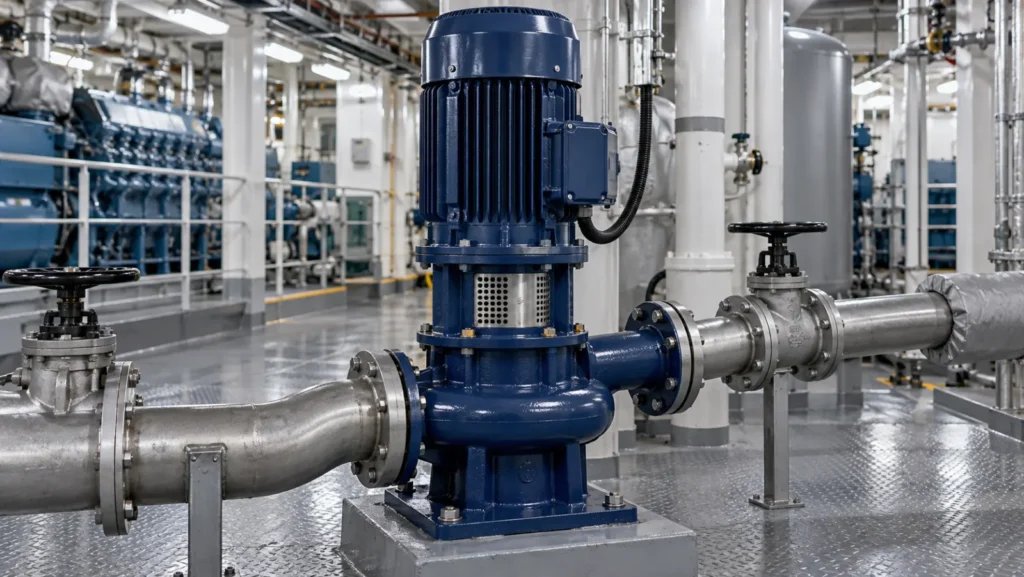
Marine centrifugal pump replacement requires more than matching the model name, motor power or flange diameter. Before ordering, compare the required duty point, suction conditions, installation dimensions, materials, electrical supply and documentation. A replacement is suitable only when the proposed configuration meets the vessel’s actual operating requirements and the installation has been checked.
This guide is for shipyard buyers, vessel engineers and marine equipment suppliers preparing a replacement enquiry. It focuses on complete pump or pump-set replacement for water duties such as cooling, ballast and bilge service. Individual spare parts require separate part-number and drawing checks.
Start with three items: clear photographs of the pump and motor nameplates, the available performance curve, and a general arrangement drawing or measured installation sketch. Together, these give a supplier a much stronger starting point than a model number alone.
On this page: Checklist · Service · Performance · Suction · Mechanical fit · Materials · Electrical supply · Documentation · Enquiry details
Marine centrifugal pump replacement checklist
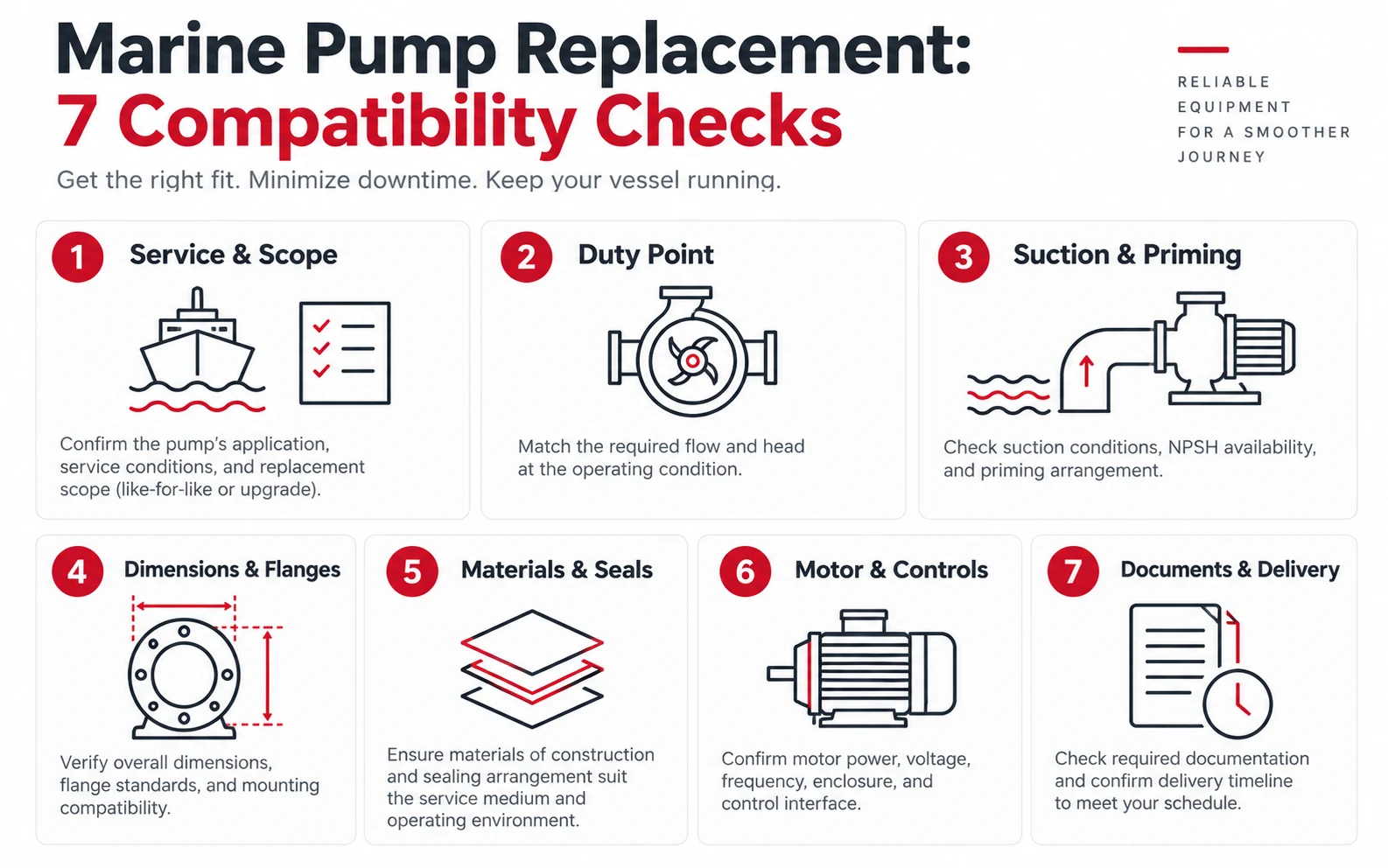
| Check | Information to compare | What needs clarification |
|---|---|---|
| Service and replacement scope | Liquid, system function, complete set or bare pump | The enquiry names a pump but does not identify its duty |
| Hydraulic performance | Required flow and head together, speed and operating range | Only maximum flow or motor kW is provided |
| Suction and priming | Suction layout, liquid level, NPSH and priming arrangement | Existing suction problems have not been investigated |
| Mechanical fit | Flange standard, dimensions, orientation and maintenance access | Nominal connection size is treated as proof of fit |
| Materials and seals | Wetted-part materials, seal arrangement and liquid conditions | The offer says only “suitable for seawater” |
| Motor and controls | Voltage, frequency, speed, starting and control requirements | A curve or motor rating is for a different supply frequency |
| Documentation and delivery | Required approvals, drawings, tests, supply scope and destination | Assumptions remain unresolved when the order is placed |
1. Define the service and replacement scope
Identify what the pump does on the vessel. A seawater cooling pump, a freshwater circulation pump and a ballast pump may all be centrifugal pumps, but their operating requirements are not interchangeable. Record the liquid, normal temperature, expected contamination and whether the unit operates continuously, intermittently or as standby equipment.
Then state what you are replacing: the complete pump set, a bare pump retaining the existing motor, or an internal assembly. Keeping the motor requires additional checks of the shaft or coupling interface, mounting arrangement, speed and available power. A complete set requires confirmation of the foundation, pipe connections and electrical interfaces.
Also explain why replacement is needed. Repeated leakage, vibration, low flow or loss of prime can involve the surrounding system as well as the pump. Replacing equipment without identifying the cause may leave the original problem unresolved. Share inspection findings and operating observations rather than asking the supplier to infer them from photographs.
2. Compare the duty point, not just the nameplate power
Request the proposed pump’s performance curve at the specified rotational speed and impeller configuration. Flow and head must be evaluated together at the required duty point. Two pumps with the same motor rating can have different hydraulic characteristics.
The operating point depends on both the pump curve and the system resistance. Check normal operation and any other expected operating conditions, including parallel operation where applicable. Ask the supplier to identify the proposed duty point, acceptable operating range and power requirement on the submitted curve. KSB’s explanation of system characteristic curves describes how the pump and system curves determine the operating point.
For example, an enquiry stating “100 m³/h and 40 m head” should mean 100 m³/h at 40 m head, not two independent maximum ratings. This is an illustrative enquiry, not a CTP model specification. If the original curve is unavailable, provide the design duty and whatever reliable operating records the vessel can supply; identify unknown values explicitly.
3. Check suction conditions and priming
Provide the pump’s position relative to the lowest operating liquid level, together with suction pipe details, strainers, valves and known restrictions. Note whether the suction is flooded or requires a suction lift, and describe the existing priming equipment.
Available net positive suction head (NPSHA) is a system condition. Required NPSH (NPSHR) belongs to the proposed pump at a particular duty. The engineering review must establish an appropriate margin rather than merely treating equal values as acceptable. See KSB’s NPSH reference for the distinction.
A self-priming device does not remove the need for this review. Ask whether the proposed supply includes the priming device and its associated services and controls. If the current pump loses prime or operates noisily, include that information in the marine centrifugal pump replacement enquiry before a model is selected.
4. Verify mechanical fit using a drawing
Use the proposed general arrangement (GA) drawing to compare the installation, not a catalogue photograph. Check suction and discharge locations, flange standards and pressure ratings, bolt-hole patterns, face-to-face dimensions, shaft centre height and foundation bolt positions. Record the required viewing direction when describing rotation or connection orientation.
Include the space needed to remove the motor, shaft, seal or other service components. A pump that fits the available footprint may still be difficult to maintain if there is insufficient lifting or withdrawal clearance. Photographs help show obstructions, but critical dimensions should be measured or taken from verified drawings.
Ask the supplier to list any proposed adapters, baseplate changes or pipework modifications. If the requirement is replacement without modifying the existing pipework, state this explicitly. Do not treat “equivalent model” as confirmation that all installation dimensions match.
5. Confirm materials and the sealing arrangement
Ask for a component-level material schedule for the casing, casing cover, impeller, shaft and relevant wear parts. Confirm the mechanical seal or packing arrangement, elastomers and any required seal services. The liquid and temperature must be identified before the proposed materials can be assessed.
CTP’s EMC selection-manual material table provides a useful example of why the service matters. It lists bronze for the seawater casing and casing cover, while the freshwater versions of those parts are cast iron. The impeller is listed as bronze and the shaft as stainless steel. The same drawing identifies packing and mechanical-seal details.
These entries describe the manual’s EMC configurations; they are not a universal material specification for every CTP pump or every seawater installation. The manual also notes that other material combinations are available on request. Confirm the offered configuration in the quotation and technical submission.
For related water duties, see the CTP marine centrifugal pump range and marine ballast pump application. Request the applicable model documentation through CTP technical support.
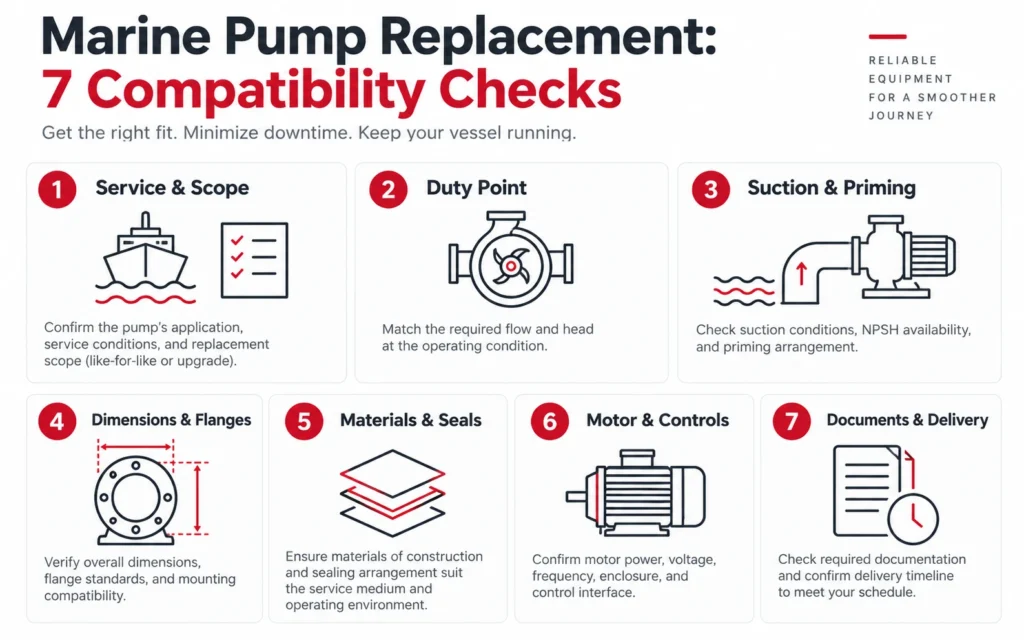
6. Match the vessel’s motor supply and controls
Copy the actual voltage, frequency, phase, rated speed and motor power from the vessel specification and motor nameplate. Also identify the starting method, variable-frequency drive if fitted, protection requirements and control interfaces. Country of delivery is not a reliable substitute for the vessel’s electrical specification.
A 50 Hz curve should not be accepted as proof of performance at 60 Hz, or vice versa. Where supply frequency changes rotational speed, hydraulic performance and absorbed power change too. KSB’s pump affinity-law reference explains the relationship and its assumptions. Obtain the manufacturer’s selection for the intended supply rather than approving a frequency conversion from a simple rule of thumb.
If the existing motor will be reused, ask for explicit confirmation that it is suitable for the proposed pump across the intended operating range. Include coupling, mounting and rotation checks in that confirmation.
7. Agree the documentation and delivery scope before ordering
Identify the vessel’s classification society, flag requirements and owner or shipyard specification at the enquiry stage. Ask which drawings, material records, performance tests and certificates are included, which need separate quotation and what review is required before manufacture or installation.
A supplier’s general certificate list is not the same as confirmation for a particular pump and vessel. For essential services, the owner, shipyard and relevant approval parties should establish the applicable requirements. IMO’s SOLAS overview explains the convention’s coverage of ship machinery and electrical installations; it does not establish approval of an individual replacement.
For enquiries involving Indonesia, Singapore or Malaysia, provide the actual delivery address or port, receiving contact and required-on-site date. Distinguish factory readiness from arrival at the vessel. Ask the quotation to identify packing, shipping terms, documentation and any commissioning support included. Availability and delivery dates must be confirmed for the specific order.
Copy this information into your replacement enquiry
Use the following list to prepare a marine centrifugal pump replacement enquiry. Mark missing items as “not available” so the supplier can identify what must be measured or confirmed next.
- Vessel and service: vessel reference, pump duty, liquid and operating temperature.
- Existing equipment: maker, model, serial number and photographs of both nameplates.
- Required performance: flow at the required head, normal operating range and available curve.
- Suction arrangement: minimum liquid level, suction pipe details and priming equipment.
- Installation: GA drawing or measured sketch, flange details, orientation and access photographs.
- Motor and controls: voltage, frequency, phase, speed, starting method and whether the motor is retained.
- Materials and sealing: existing specification, known corrosion or leakage issues and required changes.
- Order requirements: quantity, replacement scope, class and documentation requirements, destination and required-on-site date.
Before placing the order, obtain written confirmation of the proposed duty, installation fit, materials, motor configuration and any deviations. Keep the accepted technical submission with the purchase order so both teams work from the same specification.
Common compatibility questions
Can a different brand replace the existing marine centrifugal pump?
It can be evaluated, but a similar model description does not establish compatibility. Compare performance, installation, materials, motor interfaces and project documentation. Any modifications or unresolved differences should be recorded before the replacement is accepted.
Is a nameplate photograph enough to request a quotation?
It is a useful starting point. A firm technical selection may also need the original curve, duty data, installation dimensions and material requirements. Send what is available and identify missing information; do not invent values to complete the enquiry.
Does the same flange size mean the replacement will fit?
No. Flange standard, drilling, rating, orientation and spacing still need to match. Foundation dimensions and maintenance clearance must also be reviewed against the proposed GA drawing.
Discuss your marine centrifugal pump replacement with CTP
Send CTP your existing pump and motor nameplates, duty data and available drawings for a compatibility review. Browse the marine centrifugal pump options or submit the information through pump selection assistance.
For new vessel projects rather than replacement work, the marine pump selection guide for Indonesian shipyards covers the broader system-selection process.
Product reference: CTP marine centrifugal pump selection manual, EMC section, printed page 63, “Sectional View & Parts Material.” This article is a procurement checklist; final selection and installation requirements are confirmed for the specific vessel and duty.
Pingback: Ballast Pump vs Ballast Stripping Pump Explained | CTP Pumps
Pingback: EMC Pump Spare Parts & Replacement (Taiko Design) | CTP