
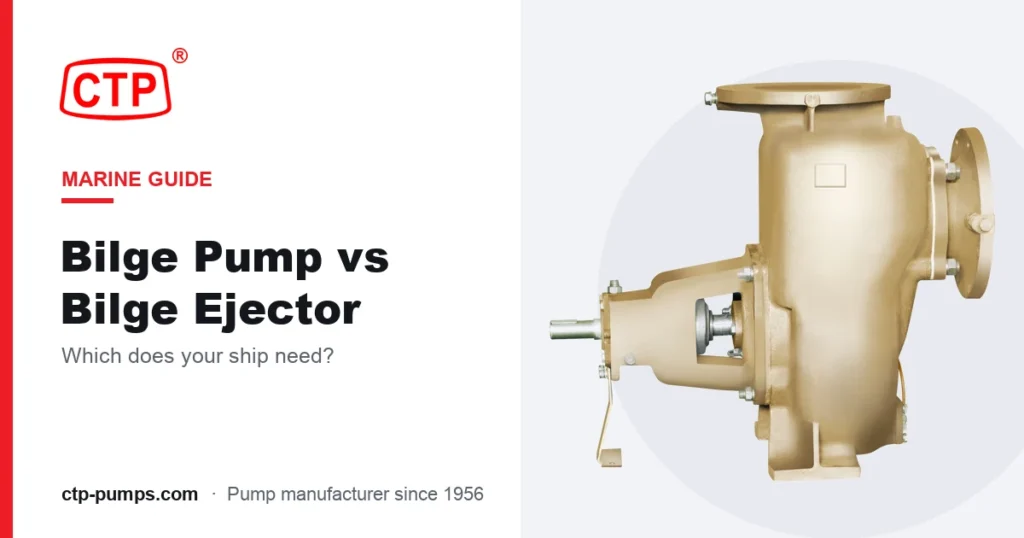
Short answer: a bilge pump is a power-driven pump, usually a self-priming centrifugal pump, that drains the engine-room bilge wells and feeds bilge water to the oily water separator. A bilge ejector (also called a bilge eductor) has no moving parts. It uses high-pressure driving water, normally from the fire and general service main, to draw water out of a space. Most ships use both. The bilge pump does the regular, controlled drainage. Ejectors serve spaces that are remote, small, hazardous or flooded, and act as a backup that needs no motor at the space.
This guide explains how each one works, compares them side by side, shows where each is used on a ship, and lists the data a pump supplier needs for each.
What a bilge pump does
Water collects at the lowest points of the hull: engine-room bilge wells, hold bilges and void spaces. It comes from leaks, condensation, wash-down water and drainage from machinery. The bilge pump removes it through the bilge main and its branch suctions.
Bilge wells sit below the pump inlet, so the pump works on suction lift and must keep pumping as the level falls and air enters the suction. That is why self-priming is the defining requirement for a marine bilge pump. A standard centrifugal pump can meet it in two ways:
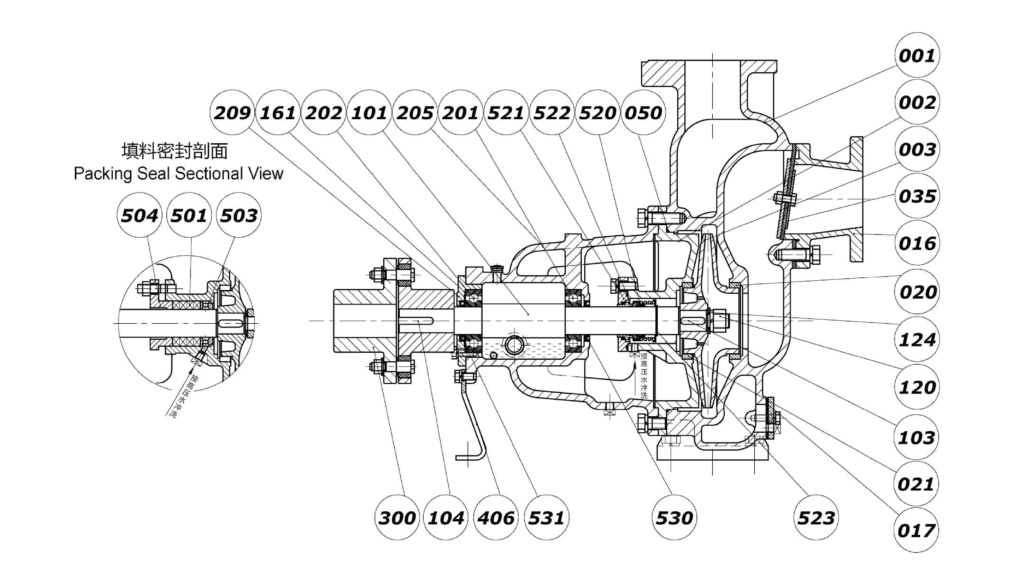
- A self-priming centrifugal pump. The CTP EHS series is a horizontal self-priming marine centrifugal pump with integral priming and air separation. A built-in swing check valve on the suction side holds the priming charge, so no external priming system is needed. The EHS covers flows up to 400 m³/h and heads up to 150 m at speeds up to 3,550 rpm.
- A centrifugal pump with a self-priming device. Where a non-self-priming pump such as the vertical ESN or VS / VS-S also serves bilge duty, CTP fits an N-20 water-ring vacuum unit, or an EPS-200 or PSA-800 air ejector, to remove air from the suction.
A bilge pump gives a controlled, steady flow at a known head. That makes it the pump that feeds the oily water separator before any discharge overboard. See the marine bilge pump page for the full series comparison and EHS parts list.
What a bilge ejector does
A bilge ejector, or eductor, is a jet pump. It has four parts in line:
- Driving nozzle. High-pressure driving water accelerates through the nozzle and leaves as a fast jet.
- Suction chamber. The jet creates low pressure around the nozzle outlet and draws bilge water in through the suction branch.
- Mixing chamber. The jet and the bilge water mix and move on together.
- Diffuser. The widening section slows the mixed stream and turns its velocity back into pressure, so it can discharge against back pressure.
Because there is no impeller, shaft or dynamic seal, an ejector has nothing to wear mechanically and nothing that can leak through a seal. It primes itself, and it handles water-air mixtures and water carrying sediment or debris. It also needs no motor or electrical supply at the space it drains, only a driving-water line.
The CTP CP series is our marine jet pump range. The driving fluid can be water, steam, air or gas; with water it works as a water ejector. The suction branch sits at right angles to the pump body, giving a compact T-shape that fits into existing pipework. The model code carries the working pressure of the driving liquid: in CP15-0.3T, 0.3 is the working-liquid pressure in MPa and T is the T-shape body.
Bilge pump vs bilge ejector: side-by-side
| Bilge pump (self-priming centrifugal) | Bilge ejector / eductor | |
|---|---|---|
| Drive | Electric motor at the pump | High-pressure driving water from another pump |
| Moving parts | Impeller, shaft, bearings, seal | None |
| Self-priming | Integral (EHS) or with a priming device | Inherent |
| Air and debris in the suction | Handled within the pump’s priming design; strainer needed | Tolerates water-air mixtures and sediment |
| Discharge volume | Bilge water only | Bilge water plus all the driving water |
| Efficiency | Higher | Lower; uses driving-water energy |
| Flow control | Steady flow at a known head | Depends on driving pressure, suction lift and back pressure together |
| Typical role | Main engine-room bilge drainage, oily water separator feed | Remote, small, hazardous or flooded spaces; backup drainage |
| Maintenance | Seal, bearings, wear rings | Check nozzle and diffuser for wear or blockage |
Where each is used on a ship
Use a bilge pump for
- Engine-room bilge wells, drained regularly through the bilge main.
- Feeding the oily water separator. The separator needs a steady feed of bilge water only. An ejector would add its driving water to the stream and increase the volume the separator must treat.
- Larger volumes, where the higher efficiency of a driven pump matters.
Use a bilge ejector for
- Spaces far from the bilge main, such as forepeak and chain locker drainage, void spaces and small compartments, where a long suction line would be hard for the bilge pump to prime.
- Cargo hold bilges and wells on some ships, driven from the fire and general service main.
- Hazardous media. With no motor and no dynamic seal at the space, an ejector can move toxic or explosive media without putting a driven machine into the hazard.
- Flooding and emergencies. An ejector keeps working when the space is flooded or has no electrical supply, as long as driving water is available.
- Stripping residual water after a main pump loses suction. The same principle is used to strip ballast tanks; see ballast pump vs ballast stripping pump.
Using both together
A common arrangement is a self-priming centrifugal bilge pump on the engine-room bilge main, plus ejectors for the remote and hazardous spaces. The ejectors take their driving water from the fire and general service pump, or the ballast pump. Check that the driving pump has enough spare capacity at the required pressure while the ejector runs, and that the discharge line can take the combined flow of driving water and bilge water.
Bilge ejector vs self-priming device: not the same thing
Air ejectors such as the CTP EPS-200 and PSA-800 are often confused with bilge ejectors. They are self-priming devices. They remove air from the suction of a centrifugal pump so the pump can prime; they do not pump the bilge water themselves. The EPS-200 primes vertical centrifugal pumps with suctions up to DN80 and the PSA-800 those above DN80; both run on compressed air at 5–9 kgf/cm². The N-20 is a water-ring vacuum unit driven from the motor coupling.
So there are three different answers to “how do I drain a bilge from below the pump”:
- a self-priming centrifugal bilge pump (EHS);
- a standard centrifugal pump with a self-priming device (N-20, EPS-200, PSA-800);
- a bilge ejector driven by water from another pump (CP).
Choosing a centrifugal bilge pump
For a centrifugal bilge pump, start from the drainage system rather than a model:
- the required flow and the total head to the discharge or separator;
- the suction lift from the lowest bilge level to the pump centreline, and the suction line length;
- the liquid: sea water, fresh water, oily water, and any sediment;
- whether the pump also serves ballast, fire or general service duty;
- the power supply (50 or 60 Hz) and the classification society.
Where the bilge carries sludge or viscous residue, a centrifugal pump is the wrong type. A single screw (eccentric helical rotor) pump handles sludge and high-solids media.
Sizing a bilge ejector
An ejector’s capacity depends on three things together: the driving-water pressure and flow, the suction lift, and the discharge back pressure. CTP therefore does not publish a single flow range for the CP series and sizes each unit against the duty. Send:
- the driving fluid available (usually sea water from the fire and general service main), with its pressure and flow;
- the liquid to be drained, its temperature, and any sediment, oil or gas;
- the required suction capacity and suction lift;
- the discharge back pressure and where the mixed stream goes;
- pipe connections, space and orientation;
- any hazard classification of the space, and the classification society.
Rules and classification
The number, capacity and type of bilge pumps on a ship are set by the SOLAS Convention and the rules of the classification society, and discharge of oily bilge water is controlled under MARPOL. Whether an ejector can be counted as one of the required bilge pumping means depends on the ship type and the class rules. Confirm the arrangement with the shipyard and class before ordering. Tell us the classification society at enquiry, and survey by that society can be arranged.
FAQ
Is a bilge eductor the same as a bilge ejector?
Yes. Eductor, ejector and jet pump are names for the same device: driving fluid passes through a nozzle and entrains the liquid to be moved. “Ejector” is common in marine use, especially when the driving fluid is water.
Can a bilge ejector replace a bilge pump?
Not for the main engine-room duty. An ejector depends on another pump for its driving water, is less efficient and adds the driving water to the discharge, so it is not suited to feeding the oily water separator. It complements the bilge pump for remote, hazardous or flooded spaces.
Does a marine bilge pump need to be self-priming?
In practice, yes. Bilge wells lie below the pump inlet and the level falls as the well empties, so the pump must prime itself and keep pumping as air enters. Use a self-priming centrifugal pump such as the EHS, or fit a priming device to a standard centrifugal pump.
What drives a bilge ejector?
Usually sea water from the fire and general service pump, sometimes from the ballast pump. Steam, air or gas can also be used as the driving fluid in a jet pump, depending on the duty.
Can an ejector handle oily bilge water?
It can move it, and with no seal there is nothing to leak at the ejector. But the driving water mixes with the oily water and increases its volume, so oily bilge water for treatment is normally handled by the bilge pump and the separator system.
For the full picture of pumps on board, see our marine and shipbuilding pump overview and the marine ballast pump page.
Get a bilge pump or ejector selection from CTP
CTP supplies self-priming centrifugal bilge pumps, self-priming devices and CP jet pumps for marine drainage. Send the vessel type, the spaces to be drained, the required flow and suction lift, and the driving water available for any ejector, and our engineers will recommend the arrangement. Use the pump selection assistance form or contact CTP Pumps.
Published by CTP Pumps · Sources: CTP marine centrifugal pump selection manual (EHS series, self-priming devices, CP jet pump); IMO SOLAS and MARPOL conventions · Last reviewed: November 14, 2026