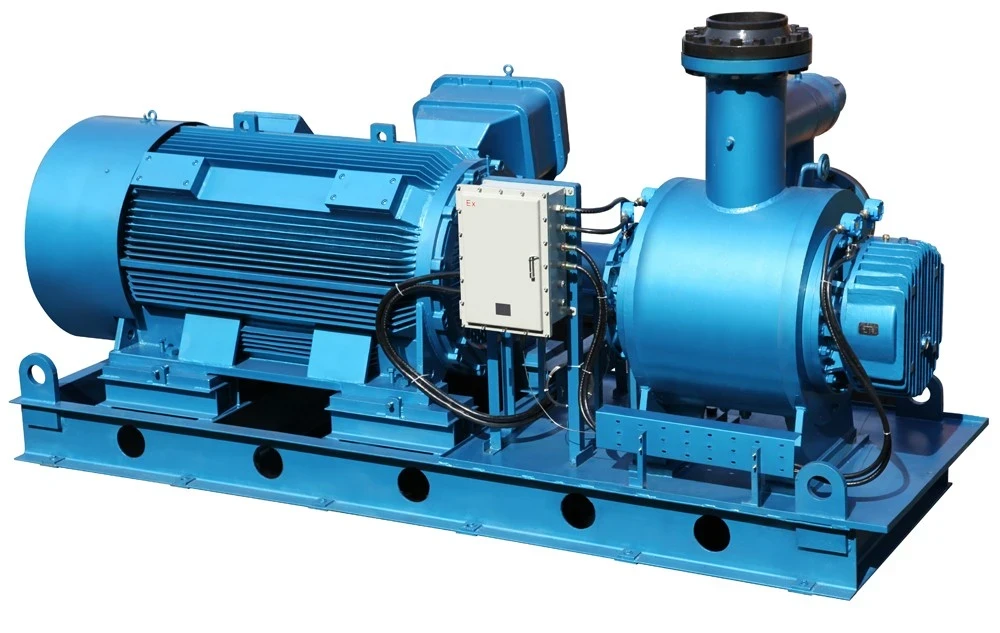
What Is a Crude Oil Transfer Pump?
A crude oil transfer pump is the pump that moves crude oil through production, midstream and refinery systems: out of storage tanks, across tank farms and terminals, between offshore storage and export, into pipelines and on to process units. The duty combines a wide viscosity span, water and sediment carried in the oil, dissolved gas, and suction conditions that change as tanks draw down.
Twin screw pumps are the CTP recommendation for this service. As rotary positive displacement machines they deliver a steady, low-pulsation flow against changing back pressure; they are self-priming with good suction capability (required NPSH from 1.5 m) and insensitive to impurities in the crude. The CTP twin screw family covers flows to 2,700 m³/h, pressures to 10.0 MPa and speeds to 1,800 rpm, for lubricating and non-lubricating, low- and high-viscosity liquids. Duty tables and technical documentation are available on our downloads page.
Crude Oil Duties the Pumps Serve
Oil & gas operators and refineries call on crude pumps differently along the supply chain. Four typical duties:
Recommended Pump Series for Crude Oil Transfer
CTP does not ask you to pick a model — send the crude grade, temperature and transfer rate, and we recommend the arrangement. For crude oil service the core range is the CTP twin screw pump range:
- W series (horizontal) — the core crude transfer pump: up to 2,000 m³/h and 4.0 MPa, crude temperatures to 250 °C; suits tank farm, terminal and heavy crude duty.
- SW series (horizontal) — the largest flow in the range at up to 2,700 m³/h and 1.6 MPa, 120 °C, for high-volume tank farm and terminal transfer.
- V series (vertical) — vertical arrangement to 1,200 m³/h and 4.0 MPa, 250 °C, where plot area is limited.
- SV series (vertical) — high-capacity vertical pump to 1,800 m³/h and 1.6 MPa, 120 °C.
- U series (submersible) — tank- or pit-mounted, 40–1,000 m³/h and 1.0 MPa, 80 °C; no long suction line to prime.
- HPW series (horizontal, high pressure) — to 1,000 m³/h at up to 10 MPa, 100 °C; the choice for pipeline booster and high-pressure crude transfer.
- Secondary options — W.Kse for small-bore viscous transfer (70 m³/h, 1.2 MPa, 250 °C) and 2G as the compact general-purpose twin screw (350 m³/h, 1.4 MPa, 180 °C).
When the crude still carries enough associated gas to form an oil-gas-water mixture, the duty is no longer single-phase transfer. It becomes multiphase boosting, which CTP covers separately with the dedicated HW multiphase series (up to 2,000 m³/h and 5.0 MPa). Send the well or stream data and we will confirm which duty applies. For a wider comparison of screw pump types in oil & gas service, read our screw pump selection guide for oil & gas applications; for tanker cargo handling, see cargo oil transfer pumps.
Twin Screw Series for Crude Oil — Comparison
Specification envelope of the series recommended for crude oil transfer:
| Series | Arrangement | Max flow (m³/h) | Max pressure (MPa) | Max temp. (°C) | Typical crude role |
|---|
| W | Horizontal | 2,000 | 4.0 | 250 | Core tank farm, terminal & heavy crude transfer |
| SW | Horizontal | 2,700 | 1.6 | 120 | Highest-volume transfer |
| V | Vertical | 1,200 | 4.0 | 250 | Space-saving transfer, heated crude |
| SV | Vertical | 1,800 | 1.6 | 120 | High-capacity vertical transfer |
| U | Submersible | 40–1,000 | 1.0 | 80 | Tank- or pit-mounted transfer |
| HPW | Horizontal | 1,000 | 10.0 | 100 | Pipeline booster, high-pressure transfer |
| W.Kse | Horizontal | 70 | 1.2 | 250 | Small-bore viscous transfer |
| 2G | Horizontal | 350 | 1.4 | 180 | Compact general-purpose transfer |
Maximum envelope values per series from the CTP twin screw pump range. All series handle high-viscosity media; the viscosity limit and operating point for your crude are confirmed against duty data. Source: CTP Pumps.
Twin Screw Construction & Key Parts
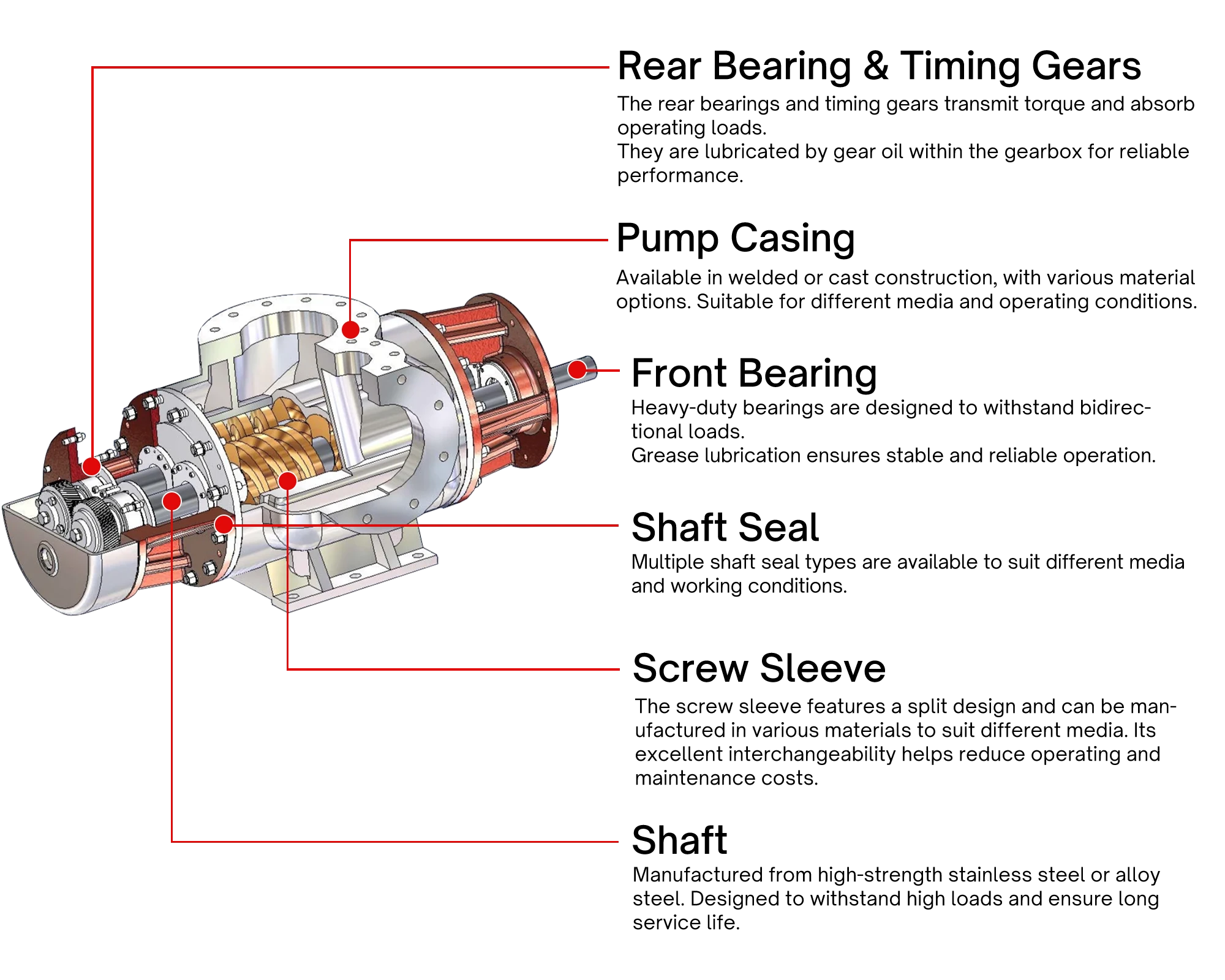
Crude transfer is hard on internals — water cut, sediment and non-lubricating light fractions all reach the pump. In the CTP twin screw design the timing gears and bearings are lubricated separately from the pumped liquid (gear oil in the gearbox, grease at the front bearing), and the wetted parts are replaceable and material-matched, so the same pump frame can be adapted to different crudes:
How to Select a Crude Oil Transfer Pump
Crude pump selection starts from the crude and the transfer system, not from a catalogue model. Provide the following and our engineers will recommend the pump, drive and sealing arrangement:
Viscosity deserves particular attention: the same crude can be many times thicker on a cold start than at normal pumping temperature. The drive is sized for the thickest condition, while the screw and clearance selection is checked at the thinnest, so the pump holds its rated flow across the range. If you are replacing an existing crude transfer pump, send the nameplate data and installation drawing — we will check how a CTP twin screw pump fits the existing foundation and piping. Unsure of the duty data? Our pump selection assistance team will work through it with you.
Standards and Certification for Crude Oil Service
Crude oil transfer pumps are specified against the operator’s project standards. Reference points that commonly apply:
- Rotary pump engineering practice — twin screw pumps are rotary positive displacement machines; design and acceptance commonly reference API 676 practice (see the API standards catalogue), with the scope of testing agreed between buyer and manufacturer.
- Quality management — CTP has operated an ISO 9001 quality system since 1994.
- Offshore and marine installations — for FPSO, platform or terminal marine duty, rules are published by societies coordinated through IACS, such as DNV, ABS and Lloyd’s Register. Survey by the requested society can be arranged.
Tell us the project specification and any certification requirements at enquiry, and we will confirm the applicable route.
FAQ: Crude Oil Transfer Pumps
What type of pump is used for crude oil transfer?
Twin screw pumps are the CTP recommendation. They deliver steady flow against changing back pressure, self-prime, tolerate impurities and handle both light and heavy crude. Depending on the arrangement, the W and SW series cover horizontal transfer, V and SV vertical installations, U tank-mounted duty and HPW high-pressure pipeline boosting.
Can one pump handle both light and heavy crude?
Often yes, within limits. Twin screw pumps handle low- and high-viscosity liquids, but the drive power, clearances and materials are chosen for the viscosity and temperature range you give us. Send data for every crude grade the pump will see, including cold-start conditions.
When does crude oil transfer become a multiphase duty?
When the stream carries free associated gas as well as oil and water — typically near the wellhead or at early production facilities. That is a multiphase boosting duty handled by the dedicated CTP HW multiphase series rather than a standard crude transfer pump. Send the gas and liquid data and we will confirm.
Which pumps are used for offshore oil transfer?
Twin screw pumps are widely used for crude transfer on offshore storage and production installations because they self-prime, handle a wide viscosity range and tolerate water and sediment in the oil. CTP offers horizontal, vertical and submersible arrangements; the series, materials and class survey are confirmed against the installation and the project specification.
What flow and pressure do CTP crude oil pumps cover?
The recommended twin screw series reach 2,700 m³/h (SW) and pressures up to 10 MPa (HPW), with W and V rated to 250 °C. The operating point within each series envelope is confirmed against your duty data.
How do I get a quotation for a crude oil transfer pump?
Send the crude grade, viscosity and temperature range, required flow and discharge pressure, suction conditions, installation type and project specification. You do not need to choose a model — our engineers recommend the pump arrangement against your duty data. Use the contact button below or our pump selection assistance page.
Published by CTP Pumps · Source: CTP Pumps product brochure (twin screw pumps) · Last reviewed: November 7, 2026