
Gear pumps and screw pumps are both positive displacement pumps, and both are considered for a range of oil-handling duties. However, they do not move liquid in the same way. Their flow characteristics, operating noise, sensitivity to viscosity and typical application range can be quite different.
Understanding the difference between a gear pump and a screw pump helps engineers avoid common selection problems such as excessive pulsation, poor suction performance, rapid wear or an unnecessarily expensive pump package. This guide compares the two technologies and explains which operating data should be reviewed before choosing a pump.
What Is a Gear Pump?
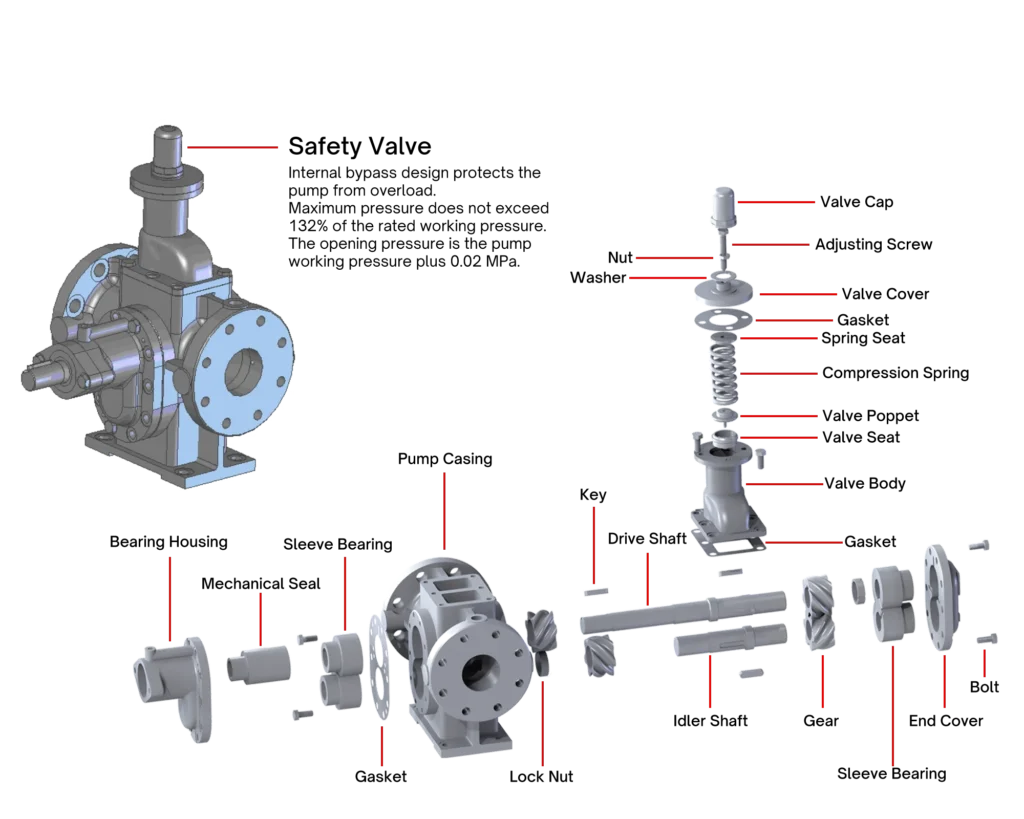
A gear pump transfers liquid by trapping it between rotating gear teeth and the pump casing. As the gears rotate, liquid is carried from the suction side to the discharge side. The meshing teeth prevent the liquid from returning directly through the center of the pump.
Gear pumps are compact, mechanically straightforward and commonly used as circulation, transfer and pressure pumps. Typical services include lubrication systems, hydraulic systems and industrial oil transfer.
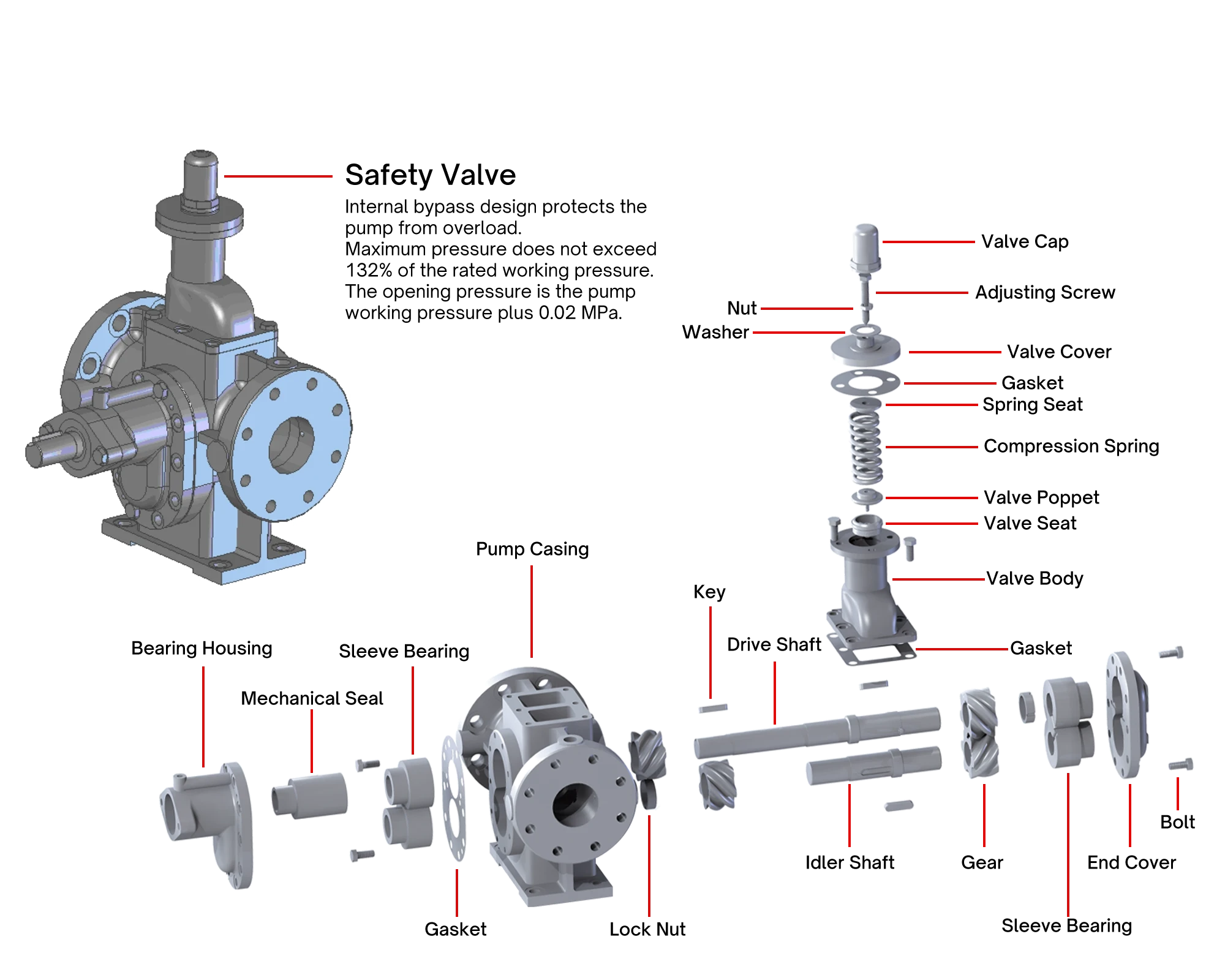
CTP Pumps manufactures five gear pump series using a herringbone arc-tooth design. The current product range is intended for lubricating oil and liquids with similar properties that are free of solid particles and fibers and are non-corrosive. Horizontal and vertical configurations are available for different installation requirements.
What Is a Screw Pump?
A screw pump moves liquid through sealed cavities formed by one or more rotating screws. In a three screw pump, a power screw drives two idler screws, creating an axial flow path through the pump. Other designs, including twin screw pumps and single screw pumps, use different internal arrangements for different media and operating conditions.
The continuous axial movement of liquid gives many screw pumps a smooth, low-pulsation discharge. This is useful in lubrication, fuel handling, hydraulic and process systems where stable flow and low vibration are important.
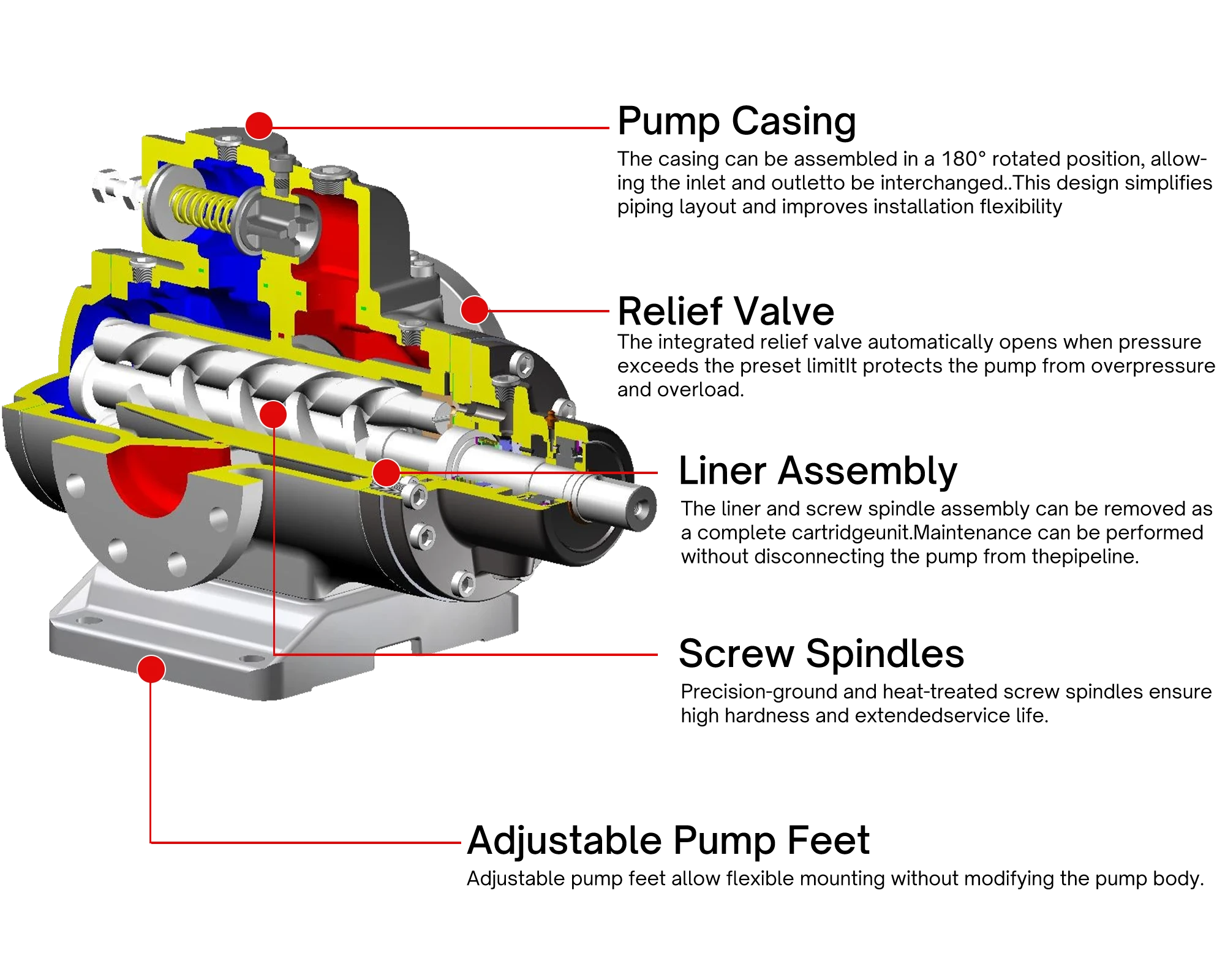
CTP three screw pumps are used for clean lubricating liquids such as lubricating oil, mineral oil and hydraulic oil, as well as selected fuel oils and other liquids within the limits of the relevant pump series. The correct model must be selected from the actual viscosity, temperature, differential pressure, suction conditions and required capacity.
Screw Pump vs Gear Pump: Main Differences
| Selection factor | Gear pump | Screw pump |
|---|---|---|
| How liquid is moved | Liquid is carried around the casing in spaces between gear teeth | Liquid moves axially through cavities formed by rotating screws |
| Flow characteristic | Positive displacement flow with some tooth-meshing pulsation | Typically smoother, with very low pulsation in many screw pump designs |
| Noise and vibration | Depends strongly on gear profile, speed, pressure and installation | Often selected where quiet, smooth operation is important |
| Typical media | Clean lubricating oils and similar non-corrosive liquids without solids or fibers | Clean lubricating liquids, fuel oils and other compatible fluids, depending on screw pump type |
| Typical duties | Lubrication, circulation, hydraulic transmission and oil transfer | Lubrication, fuel transfer, hydraulic, process and marine oil systems |
| Construction | Compact and relatively simple | More specialized internal geometry and tighter application-specific selection |
| Selection sensitivity | Clearance, viscosity, speed and pressure affect efficiency and wear | Viscosity, inlet conditions, speed, screw clearances and differential pressure are critical |
This table describes typical behavior, not a universal performance guarantee. Both categories contain multiple designs, and the final choice must be based on the manufacturer’s data for the specific series.
1. Flow Pulsation and System Stability
The most noticeable screw pump and gear pump difference is often the discharge flow characteristic. A gear pump creates small pressure and flow variations as successive gear teeth enter and leave mesh. Good gear geometry and correct operating speed can reduce these variations, but they remain part of the pumping mechanism.
A screw pump transfers liquid continuously along the screw axis. Three screw pumps are therefore frequently chosen for lubrication and fuel systems that require smooth flow, low vibration and stable pressure. Reduced pulsation can also benefit control valves, instruments and downstream equipment.
2. Viscosity and Liquid Properties
Both pump types can handle oils, but viscosity affects power demand, internal leakage, suction performance and permissible speed. A pump that works well with warm lubricating oil may not perform correctly when the same oil is cold and much more viscous.
Gear pumps are a practical option for clean lubricating oils within their published viscosity range. Screw pumps cover a broad range of oil duties, but the appropriate screw design matters. A three screw pump is normally associated with clean, lubricating fluids. Twin screw pumps may be considered for other high-viscosity or multiphase duties when the selected series is designed for those conditions.
Do not choose either pump from the fluid name alone. Provide the viscosity at minimum, normal and maximum operating temperature, together with density, lubricity, solids content and corrosiveness.
3. Pressure, Capacity and Speed
Positive displacement pumps generate flow; system resistance creates pressure. Differential pressure therefore affects shaft power, bearing load, internal leakage and component life. A relief valve or another suitable overpressure protection device is normally required in a positive displacement pump system.
Gear pumps are widely used for moderate-capacity circulation and pressure duties. Screw pumps are available in compact lubrication units as well as larger transfer systems. Neither name alone tells you the available pressure or capacity. Always compare the required duty point with the operating envelope of the specific pump series.
For reference, CTP’s published gear pump range covers five series, while its three screw pump range includes multiple horizontal, vertical, flanged and other installation arrangements. These product ranges should be reviewed series by series rather than treated as a single universal specification.
4. Suction Conditions and Cavitation Risk
Viscous liquid can create substantial pressure loss in suction piping. Long pipe runs, undersized strainers, cold oil, high speed and insufficient static head can prevent the pump from filling correctly. The result may be noise, vibration, reduced capacity, cavitation damage or dry running.
Some screw pumps offer good self-priming performance, but that does not remove the need for an inlet calculation. Gear pumps also require a properly sized, short and unrestricted suction line. For either technology, confirm the available suction pressure or NPSH, pipe diameter, strainer pressure drop, tank level and startup temperature.
5. Maintenance and Life-Cycle Considerations
Gear pumps have a compact structure and are often straightforward to service. Wear at gear teeth, shafts, bearings, bushings and casing clearances can increase internal leakage and reduce delivered capacity.
Screw pumps are valued for smooth operation and long service in correctly selected oil systems. Their performance also depends on internal clearances, bearing condition, alignment, seal condition and clean lubrication. Contamination or operation outside the permitted viscosity and pressure range can shorten service life.
Maintenance decisions should consider more than the initial pump price. Review expected operating hours, spare-parts availability, seal arrangement, alignment requirements, monitoring points and the cost of unplanned shutdowns.
When Should You Choose a Gear Pump?
A gear pump is often a strong candidate when:
- The liquid is a clean, non-corrosive lubricating oil or a fluid with similar properties.
- The required flow is within a compact or moderate-capacity range.
- The duty is oil circulation, transfer, pressurization or hydraulic transmission.
- Simple construction and a compact installation are priorities.
- The system can accept the flow characteristic of the selected gear design.
Review the CTP gear pump range for available horizontal and vertical configurations.
When Should You Choose a Screw Pump?
A screw pump is often a strong candidate when:
- Smooth, low-pulsation flow is important.
- The application is a lubricating oil, fuel oil, hydraulic or marine oil system.
- Low vibration and quiet operation are important to the package.
- The required capacity, pressure or installation arrangement matches an available screw pump series.
- The liquid properties suit the selected screw pump design.
For clean lubricating liquids, review the CTP three screw pump range. For high-viscosity or specialized transfer duties, the CTP twin screw pump range may also be relevant. Engineers who need more background can read the guide to the three screw pump working principle.
Information Required for Pump Selection
Before requesting a quotation or comparing models, prepare the following operating data:
- Liquid name and composition
- Viscosity at startup, normal and maximum temperature
- Density and lubricating properties
- Required flow rate
- Suction pressure, tank level and piping arrangement
- Discharge pressure and total differential pressure
- Operating and design temperature
- Solids, fibers, gas content or corrosive components
- Required materials and sealing arrangement
- Installation orientation, motor supply and area classification
- Continuous or intermittent operating profile
Supplying complete data is more reliable than selecting from a single keyword such as “oil gear pump” or “screw oil pump.” It allows the manufacturer to check speed, power, clearances, suction performance and material compatibility.
Frequently Asked Questions
Is a screw pump the same as a gear pump?
No. Both are positive displacement rotary pumps, but a gear pump moves liquid around meshing gears, while a screw pump moves liquid axially through cavities formed by rotating screws.
Which pump produces smoother flow?
Screw pumps typically produce smoother, lower-pulsation flow. Actual performance depends on pump design, speed, liquid viscosity and the complete piping system.
Can both pumps transfer lubricating oil?
Yes, when the oil properties and operating conditions fall within the selected model’s limits. Viscosity at startup and operating temperature is especially important.
Can a gear pump handle solids?
The published CTP gear pump range is intended for liquids free of solid particles and fibers. Solids can damage internal surfaces or interfere with clearances. A different pump design may be required for contaminated or solids-bearing media.
What does “screw gear pump” mean?
“Screw gear pump” is sometimes used informally in searches, but screw pumps and gear pumps are separate pump categories. Confirm the actual internal pumping element before selecting or replacing a unit.
Conclusion
The central difference between a screw pump and a gear pump is the pumping mechanism: gears carry liquid around the casing, while screws move it axially through continuous cavities. Gear pumps offer compact construction for many clean-oil duties. Screw pumps are frequently chosen when smooth flow, low pulsation and specialized oil-system performance are priorities.
The correct choice cannot be made from pump type alone. Send CTP Pumps your liquid properties, operating temperatures, required flow, suction conditions and differential pressure for a series-specific recommendation.
Request pump selection assistance from CTP Pumps