

Short answer: the ballast pump moves the bulk of the ballast water into and out of the tanks. The ballast stripping pump — or, on many ships, an eductor or a self-priming device fitted to the main pump — removes the last water that the main pump can no longer reach once the tank level falls and air starts to enter the suction. Most vessels need both functions, and the right split depends on tank layout, suction lift and how dry the tanks must be pumped.
This guide explains what each one does, the three common ways ships strip ballast tanks, and what to send a pump supplier so both duties are specified correctly.
The main ballast pump: moving the volume
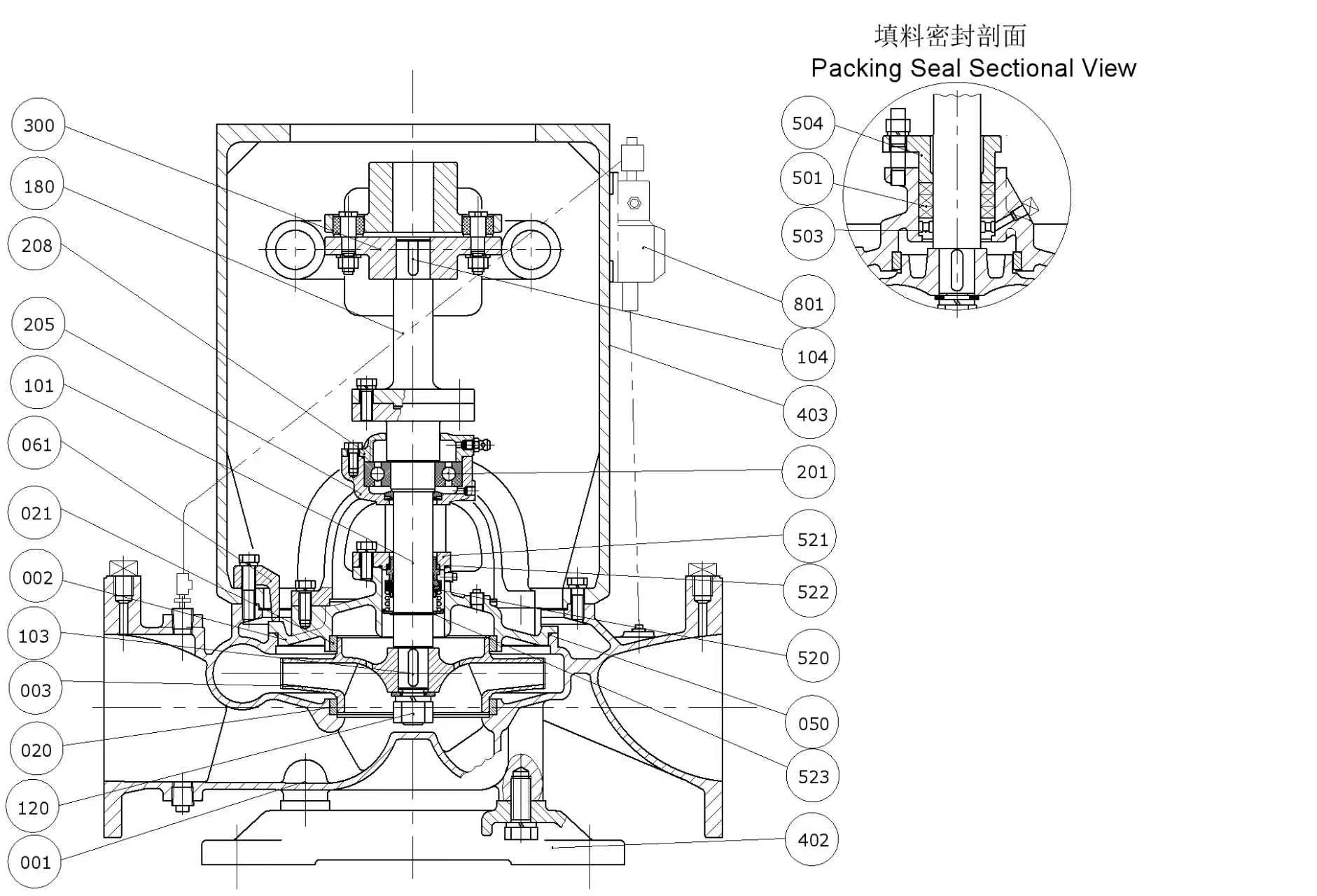
A ship’s ballast pump is a sea-water centrifugal pump that fills and empties ballast tanks to control draft, trim and stability during loading, discharge and voyage. Its job is volume: moving hundreds or thousands of cubic metres per hour within the time the port operation allows.
Because the flow is large and the head is usually moderate, main ballast pumps are typically vertical centrifugal pumps installed low in the engine room or pump room. In the CTP range the ballast series are:
- ESD and EMD — vertical single-stage double-suction pumps for large-flow ballast and main sea-water service, up to 3,000 m³/h and 50 m of head. The double-suction impeller gives practically zero axial force; EMD is rigidly coupled, so no pump-to-motor alignment is needed.
- EMC — vertical single-stage pump with the motor rigidly coupled, 5–450 m³/h and heads up to 150 m, for general ballast, cooling and general service.
- ESC, EHC, EHS, VS / VS-S and ESN — secondary or combined-duty options, for example where one pump also serves bilge, fire and general service, or where a horizontal self-priming pump suits the layout.
Materials matter as much as hydraulics: ballast pumps handle sea water, so wetted parts are bronze, with stainless-steel shafts and SiC / SiC mechanical seal faces or packing. See the full selection on our marine ballast pump page.
Why stripping is a separate job
A centrifugal pump needs a flooded impeller to pump. As a ballast tank empties, the water level approaches the suction bellmouth, vortices form and air is drawn in. At that point the main pump’s flow drops, it may lose prime altogether, and running it on in that condition risks cavitation and seal damage.
The water left in the tank at that moment — plus the water held in the suction line — still has to come out, for three reasons:
- Stability and deadweight — unpumpable ballast is weight the ship carries instead of cargo, and free surface in slack tanks affects stability.
- Sediment — residual water left in tanks is where sediment settles.
- Ballast water management — under the IMO Ballast Water Management Convention, ships manage the ballast water and sediments they take on and discharge, so leaving large residual volumes in tanks is undesirable.
That final low-level, air-entraining duty is what “stripping” means. It needs a device that keeps pumping when the suction carries a water-air mixture.
Three ways to strip a ballast tank
1. An eductor (jet pump)
An eductor uses high-pressure driving water — often from the ballast pump discharge or the fire and general service main — to entrain the residual water through a nozzle. It has no moving parts, no mechanical drive and no dynamic seal, it primes itself, and it tolerates water-air mixtures and water carrying sediment. That is why eductors are widely used for ballast stripping. The trade-off is that the driving water is added to the discharge, and efficiency is lower than a driven pump. CTP’s marine jet pump is the CP series; each unit is sized against the available driving pressure, suction lift and discharge back-pressure.
2. A self-priming device on the main ballast pump
A normal centrifugal ballast pump can be made self-priming by fitting a priming device, so it can re-prime and continue drawing down the tank as air enters the suction:
- N-20 vacuum pump unit — a water-ring vacuum pump driven by a friction wheel from the motor coupling. It evacuates air from the suction until the pump primes, disengages automatically when discharge pressure builds, and restarts if gas accumulates again. It is fitted to ballast, bilge and fire pumps.
- EPS-200 and PSA-800 air ejectors — compressed-air driven (5–9 kgf/cm²), no moving parts, operated automatically by a time relay or switchgear. EPS-200 is used on vertical centrifugal pumps with suction up to DN80; PSA-800 above DN80.
These are accessories for the centrifugal pump, not pumps in their own right. They extend how far the main pump can draw the tank down; a separate stripping device may still be specified for the final residue, depending on the ship’s arrangement.
3. A dedicated self-priming stripping pump
Some arrangements use a smaller self-priming pump dedicated to stripping and to draining suction lines. A horizontal self-priming centrifugal pump such as the EHS — integral priming and air separation, no external priming system, built-in swing check valve on the suction side — handles water that carries air well. Where the residue is heavy with sediment or sludge, a positive displacement single screw pump is the more robust choice; the same logic applies to sludge-laden bilge, covered on our marine bilge pump page.
Ballast pump vs stripping options — comparison
| Function | Typical equipment | Handles air in suction? | Typical role |
|---|---|---|---|
| Main ballast transfer | Vertical centrifugal pump (ESD / EMD / EMC) | No — needs flooded suction or a priming device | Filling and emptying tanks at full flow |
| Priming and draw-down | N-20 vacuum unit or EPS-200 / PSA-800 air ejector on the main pump | Yes — removes air so the pump re-primes | Extends how low the main pump can pump the tank |
| Final stripping | Eductor / jet pump (CP) | Yes — pumps water-air mixtures | Removes residual water and suction-line contents |
| Dedicated stripping / line draining | Self-priming centrifugal (EHS); single screw for sludge-laden residue | Yes | Stripping where no driving water is available, or residue with sediment |
How ballast water treatment changes pump sizing
Many ships now route ballast water through a ballast water management system (BWMS) — typically filtration followed by treatment — to meet the IMO BWM Convention discharge standard. For the pump, the system is extra resistance in the line. When a treatment system is added on an existing ship, or specified on a new build, the head calculation must include:
- the pressure drop across the filter and treatment unit at the required flow;
- any minimum inlet pressure the treatment system needs to operate;
- the flow range the system is rated for, which may be narrower than the ballast pump’s full envelope.
If the existing ballast pump cannot deliver the required flow against the added head, the options are a different impeller or pump selection within the same footprint, or a replacement pump. Our marine centrifugal pump replacement guide covers the seven compatibility checks for a replacement.
What to send when specifying ballast and stripping pumps
- Vessel type, ballast capacity and the time allowed to ballast and deballast (this sets the required flow)
- Total head at the duty point, including any ballast water treatment system in the line
- Suction conditions: pump position relative to tank bottoms, suction lift and suction pipe layout
- How stripping is to be done: eductor with driving water from which main, a priming device, or a dedicated stripping pump
- Power supply (50 / 60 Hz), motor standard and classification society
- For replacements: nameplate data, drawings and photos of the existing pump and foundation
You do not need to choose the model. Send the data through our pump selection assistance page and our engineers will recommend the ballast pump, the priming or stripping arrangement and the materials. Technical documentation is on our downloads page.
FAQ
What is a ballast stripping pump?
It is the pump or device that removes the last water from a ballast tank after the main ballast pump can no longer draw it, because the level is too low and air is entering the suction. On many ships this job is done by an eductor (jet pump) rather than a separate driven pump.
What type of pump is used as a ballast pump on a ship?
A sea-water centrifugal pump, usually vertical and built in bronze. In the CTP range, the ESD and EMD double-suction series cover large-flow ballast duty up to 3,000 m³/h, and the EMC series covers 5–450 m³/h with heads up to 150 m.
Can the main ballast pump also strip the tanks?
Partly. Fitted with a self-priming device such as the N-20 vacuum unit or an EPS-200 / PSA-800 air ejector, a centrifugal ballast pump can re-prime and draw the tank lower. Final stripping of the residue is commonly left to an eductor or a dedicated self-priming pump.
Is a ballast water pump different from a ballast pump?
The terms are generally used for the same pump — the sea-water pump that fills and empties ballast tanks. What changes with ballast water management is the system around it: a treatment system in the line adds resistance that must be included in the pump’s head.
Which pump suits sea water ballast service?
One with sea-water materials — bronze casing and impeller, stainless-steel shaft and a sea-water-rated seal — sized for the vessel’s ballast flow and head. Send your duty data and we will recommend the series and materials.
Discuss your ballast system with CTP
CTP Pumps has built marine centrifugal pumps since 1956, with marine centrifugal technology licensed from Taiko (Japan) in 1994. Send the ballast capacity, deballasting time, head and suction data for your vessel, and we will recommend the ballast pump and stripping arrangement. Contact CTP Pumps or see our marine ballast pumps.
Published by CTP Pumps · Sources: CTP marine centrifugal pump selection manual and product brochure · Last reviewed: September 29, 2026