What Is a Marine Bilge Pump?
A marine bilge pump is the pump that drains the bilge wells and hold spaces at the lowest points of a vessel’s hull and machinery spaces — removing accumulated water, oily mixtures and contaminated service water so the ship stays stable, dry and compliant. Bilge duty is intermittent but unforgiving: the pump must start against a falling suction level, tolerate air and vapour, and handle water carrying oil, sediment and debris.
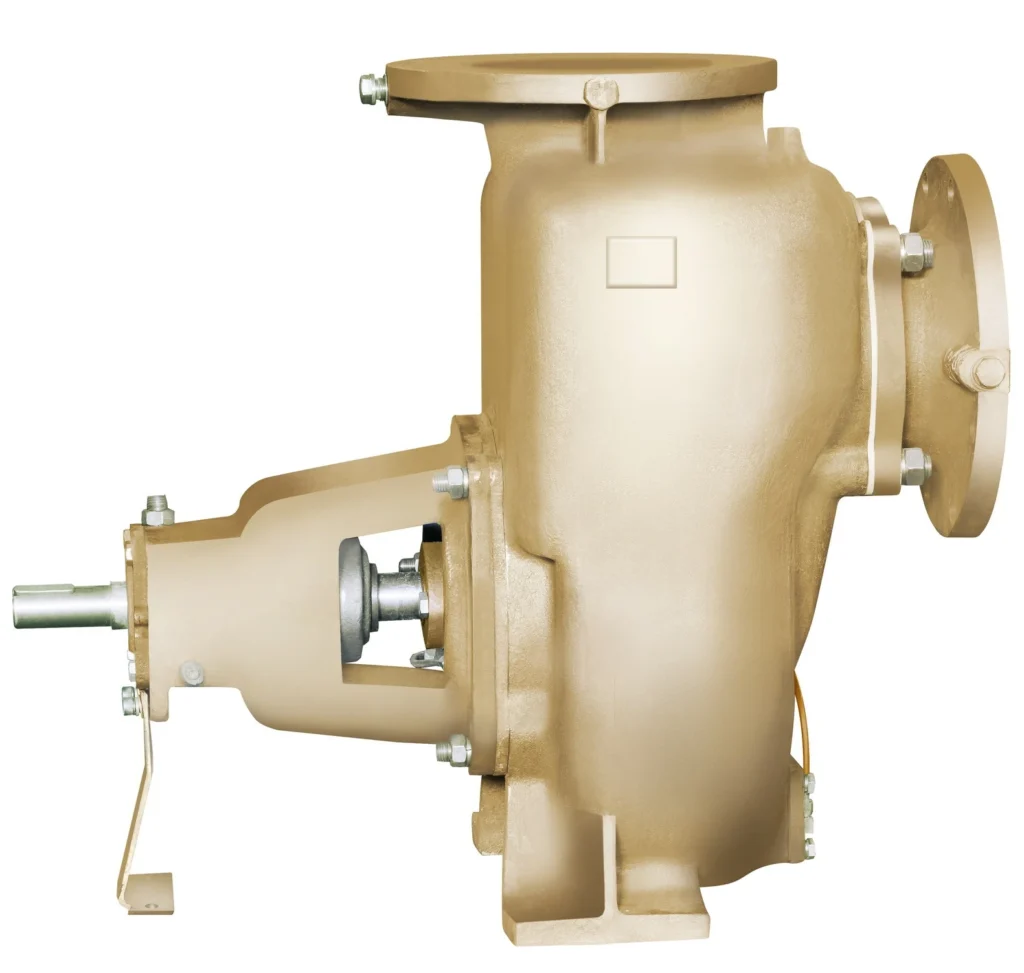
Because bilge wells drain below the pump inlet, self-priming capability is the defining requirement. The CTP EHS horizontal self-priming marine centrifugal pump meets it with an integral priming and air-separation structure — no external priming system — covering flows to 400 m³/h and heads to 150 m at speeds up to 3,550 rpm. Duty tables and technical documentation are available on our downloads page.
Bilge Duties the Pumps Serve
A ship’s bilge and drainage system calls on pumps differently by space and content. Three typical duties:
Engine-room bilge drainage
The main machinery-space bilge wells collect leakage, condensation and wash-down water. A self-priming centrifugal pump (EHS) drains them reliably as the level falls below the pump inlet.
Oily water & separator feed
Bilge water passes through the oily-water separator before any discharge overboard. The bilge pump feeds the separator at a steady rate and must tolerate the oil-water mixture without losing prime.
Sludge-containing bilge
Where bilge and hold spaces carry sludge, sediment or viscous residues, a single screw pump (G / EH / ER / EU family) is the correct choice — see the eccentric helical rotor range.
Recommended Pump Series for Bilge Duty
CTP does not ask you to pick a model — send the vessel type and duty data, and we recommend the arrangement. For bilge service the starting point is the self-priming centrifugal range:
- EHS series (horizontal, self-priming) — the bilge hero: integral priming and air separation with a built-in swing check valve on the suction side, so no external priming system and no suction valve are needed; flows to 400 m³/h, heads to 150 m.
- TMS series (horizontal, self-priming) — self-priming daily-service pump that also covers bilge and cooling standby on smaller systems.
- ESN series (vertical, two-outlet) — combination service pump for vessels where one unit serves bilge, ballast and sea-water / fresh-water duties.
- Secondary options — EHC horizontal and VS / VS-S vertical two-stage pumps suit bilge and general-service duty where flooded suction or a priming device is available.
Where a non-self-priming centrifugal pump must be used on suction lift, CTP fits a self-priming device — the N-20 vacuum pump unit, or the EPS-200 / PSA-800 air ejectors (EPS-200 for suction DN ≤ 80 mm, PSA-800 above). Full specifications are on the marine centrifugal pump range page, or ask for selection assistance. For ballast duty on the same vessel, see our marine ballast pumps.
Centrifugal Series for Bilge — Comparison
How the recommended series differ for bilge service:
| Series | Arrangement | Self-priming | Typical bilge role |
|---|
| EHS | Horizontal, end suction | Integral — no external device | Primary engine-room & general bilge on suction lift |
| TMS | Horizontal, self-priming | Integral — no external device | Daily service / sanitary; bilge & cooling standby |
| ESN | Vertical, two-outlet | With priming device | Combined bilge + ballast / sea-water & fresh-water |
| EHC | Horizontal | With priming device | Bilge & general service where flooded suction exists |
| VS / VS-S | Vertical, two-stage | With priming device | Fire & general service; bilge and ballast secondary |
“With priming device” means the N-20 vacuum pump or an EPS-200 / PSA-800 air ejector is fitted. The operating point within each series envelope is confirmed against your duty data. Source: CTP Pumps marine centrifugal pump selection manual.
EHS Construction & Key Parts
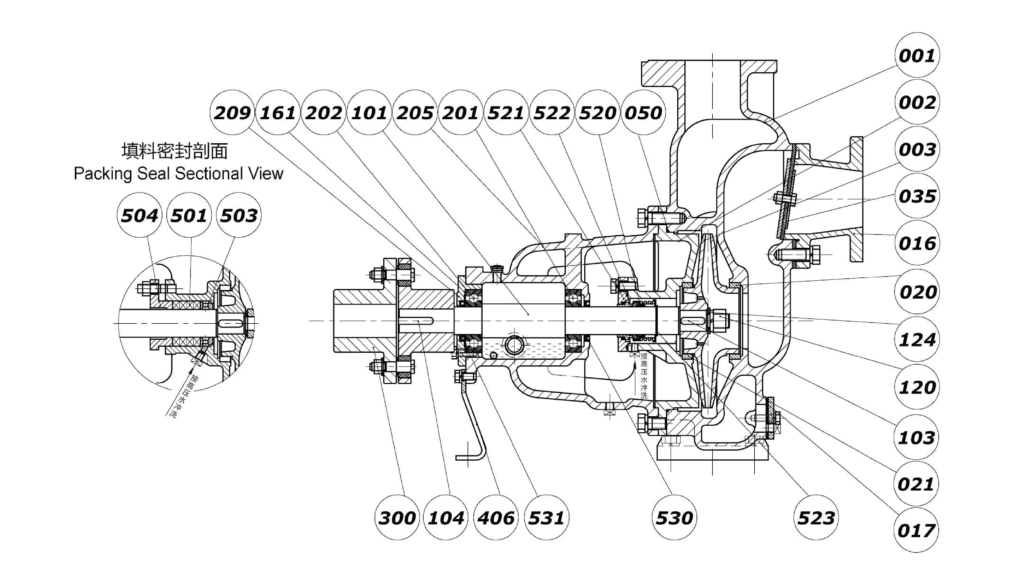
Bilge water is abrasive and corrosive — sediment, oil and sea water together. The EHS is built around a double-volute casing that retains a priming charge, a built-in swing check valve on the suction side, and replaceable bronze wetted parts, so the same pump frame serves sea-water and contaminated bilge duty:
The numbered parts of the sectional drawing are listed below with materials for sea-water (S.W.) bilge duty. The built-in swing check valve (035) is what lets the EHS hold its priming charge without an external suction valve; the casing (001) retains the liquid volume used for re-priming.
EHS parts list — sea-water bilge duty
| No. |
Part |
Material (S.W.) |
| 001 |
Pump Casing |
Bronze |
| 002 |
Pump Cover |
Bronze |
| 003 |
Impeller |
Bronze |
| 016 |
Suction Cover |
Bronze |
| 017 |
Drain Cover |
Bronze |
| 020 |
Wear Ring |
Bronze |
| 021 |
Wear Ring |
Bronze |
| 035 |
Check Valve (built-in swing) |
Stainless Steel + NBR |
| 050 |
O-ring |
NBR |
| 101 |
Shaft |
Stainless Steel |
| 103 |
Impeller Key |
Stainless Steel |
| 104 |
Coupling Key |
Carbon Steel |
| 120 |
Impeller Nut |
Stainless Steel |
| 124 |
Impeller Washer |
Stainless Steel |
| 161 |
Wave Gasket |
Carbon Steel |
| No. |
Part |
Material (S.W.) |
| 201 |
Ball Bearing |
Bearing Steel |
| 202 |
Ball Bearing |
Bearing Steel |
| 205 |
Bearing House |
Cast Iron |
| 209 |
Bearing Cover |
Cast Iron |
| 300 |
Coupling |
Carbon Steel + Rubber |
| 406 |
Support |
Carbon Steel |
| 501 |
Packing |
Carbonized Fiber |
| 503 |
Lantern Ring |
Bronze |
| 504 |
Packing Cover |
Bronze |
| 520 |
Mechanical Seal |
Seal faces: SiC + SiC |
| 521 |
Seal Cover |
Bronze |
| 522 |
O-ring |
NBR |
| 523 |
Retaining Ring |
Stainless Steel |
| 530/531 |
Oil Seals |
NBR |
Materials shown for sea-water (S.W.) bilge duty; fresh-water (F.W.) builds use cast-iron casing, cover, suction and drain covers. Other material combinations at request. Source: CTP Pumps.
How to Select a Bilge Pump
Bilge pump selection starts from the vessel’s drainage system and the spaces to be served, not from a catalogue model. Provide the following and our engineers will recommend the pump, motor and sealing arrangement:
- Required bilge flow and total head (per drainage plan)
- Vessel type and the spaces to be drained (engine room, holds, cofferdams)
- Suction conditions — lift or flooded (determines self-priming need)
- Media: clean bilge water, oily mixture, or sludge-containing
- Power supply (50/60 Hz) and motor standard
- Classification society and flag state
Pay particular attention to priming and NPSH: as a bilge well drains, the available suction head falls and air entrainment rises — this is exactly where a non-self-priming centrifugal pump loses prime. The EHS holds prime through these conditions by design. If you are unsure of the duty data, our pump selection assistance team will work through it with you.
Standards and Classification for Bilge Service
Bilge drainage is a statutory safety duty — pumps and the bilge system are surveyed with the ship. Reference points that commonly apply:
- Statutory bilge drainage — bilge pumping arrangements are required by the IMO SOLAS Convention; pump capacity and redundancy are part of the ship’s safety construction.
- Classification society rules — machinery and bilge-system requirements are published by societies coordinated through IACS, for example DNV, Lloyd’s Register and CCS. Survey and certification can be arranged with the requested society.
- Engineering practice — centrifugal pump design and acceptance commonly reference the ISO 5199 framework, with acceptance testing agreed between buyer and manufacturer.
Tell us the classification society and flag state at enquiry, and we will confirm the applicable certification route.
FAQ: Marine Bilge Pumps
What pump is used for bilge water on ships?
A self-priming centrifugal pump is the standard choice for engine-room and general bilge drainage. CTP recommends the horizontal EHS series as the primary bilge pump because it primes itself without an external priming system; the TMS and ESN series cover daily-service and combined-duty variants, and single screw pumps handle sludge-containing bilge.
Does a bilge pump need to be self-priming?
Yes in almost every case. Bilge wells sit below the pump inlet, so the pump must lift and hold prime as the level falls. The EHS does this with an integral priming and air-separation structure and a built-in swing check valve. Where a non-self-priming pump is used, a N-20 vacuum pump or EPS-200 / PSA-800 air ejector is fitted to provide priming.
Can one pump handle oily bilge water and sludge?
Oily bilge water is fine for a centrifugal bilge pump feeding the oily-water separator. Sludge, sediment and viscous residues are not — those duties go to a single screw pump (G / EH / ER / EU family). Tell us the expected solids content and we will split the duties correctly.
What flow and head do CTP bilge pumps cover?
The EHS self-priming range extends to 400 m³/h and 150 m of head at speeds up to 3,550 rpm. Combined-duty and secondary series cover the rest of the envelope. Send your drainage plan and we will confirm the operating point.
How do I get a quotation for a bilge pump?
Send the vessel type, spaces to be drained, required flow and head, suction conditions, media (clean / oily / sludge), power supply and classification society. You do not need to choose a model — our engineers recommend the pump arrangement against your duty data. Use the contact button below or our pump selection assistance page.
Ready to Discuss Your Marine Bilge Pump Duty?
Send the vessel type and drainage data for your ship — we will recommend the pump model, materials and certification route.
Published by CTP Pumps · Source: CTP Pumps marine centrifugal pump selection manual · Last reviewed: September 23, 2026