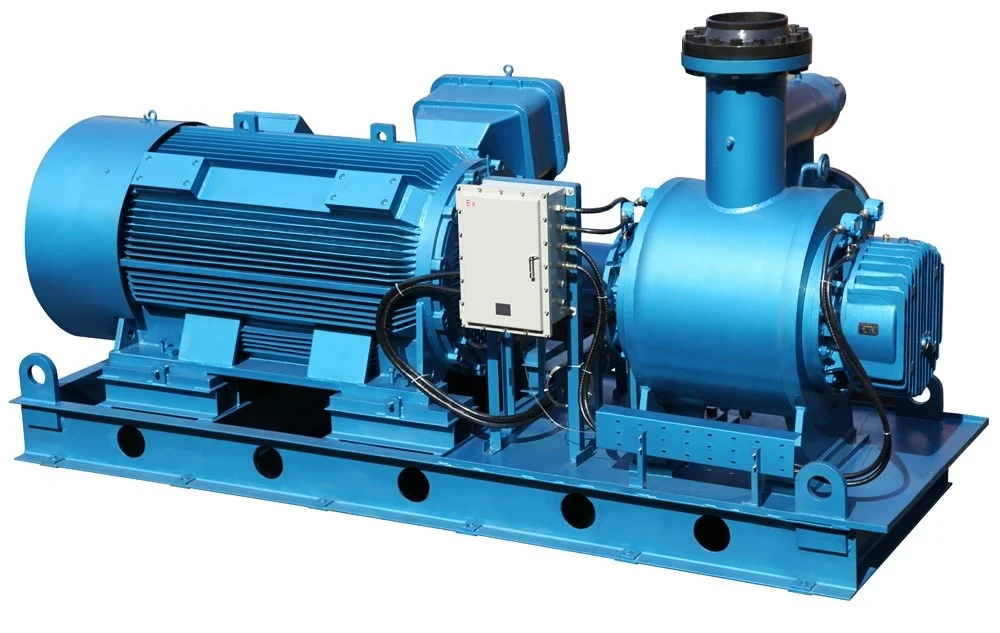
What Is a Cargo Oil Pump?
A cargo oil pump is the pump in a tanker’s cargo handling system that loads, discharges and strips liquid cargo — crude oil, refined products, chemicals and other viscous or heated liquids. Unlike sea-water duties, cargo pumping works against varying discharge back pressure, handles vapour released by the cargo, and must recover residual liquid down to tank bottoms during stripping.
Twin screw pumps are the standard CTP recommendation for this duty: screw geometry keeps flow almost constant across the full pressure range, tolerates gas entrainment as tank levels drop, and runs dry during stripping without damage. The CTP twin screw range covers flow rates up to 2,700 m³/h, differential pressures up to 10 MPa, viscosities up to 10⁵ cSt and cargo temperatures up to 350 °C, in horizontal, vertical and submersible arrangements. Duty tables and technical documentation are available on our downloads page.
Cargo Operations the Pumps Serve
A tanker’s cargo system uses pumps differently across the voyage cycle. Based on the arrangements in the CTP twin screw range, three typical duties:
Loading & discharge
Main cargo pumps transfer cargo between ship and shore at high, steady rates. Horizontal W and SW series cover the largest flow demands; vertical V and SV series fit pump rooms with limited floor area.
Tank stripping
As tank levels fall, screw pumps keep pumping through gas entrainment and vapour pockets and tolerate dry running — recovering residual cargo, reducing slop volume and improving outturn figures.
Tank-mounted & slop duty
Submersible U series pumps sit directly in cargo or slop tanks, eliminating long suction lines and priming systems entirely.
Recommended Pump Series for Cargo Oil Duty
CTP does not ask you to pick a model — send the cargo type, temperature and discharge rate, and we recommend the arrangement. For cargo oil service the starting point is the CTP twin screw pump range:
- W series (horizontal) — the flagship cargo pump: up to 2,000 m³/h and 4.0 MPa with cargo temperatures to 350 °C; suits main discharge on crude oil and product tankers.
- SW series (horizontal) — the largest flow in the range at up to 2,700 m³/h for large tankers and terminal transfer rates.
- V & SV series (vertical) — vertical shaft line saves pump-room floor space; up to 1,200 m³/h (V) and 1,800 m³/h (SV).
- U series (submersible) — tank or slop tank mounted, 40–1,000 m³/h; no suction piping or priming system required.
- Secondary options — HPW for high-pressure duties up to 10 MPa; W.Kse for small-bore viscous and chemical transfer; 2G as the compact general-purpose twin screw up to 350 m³/h. The HW series is reserved for oil-gas-water multiphase duty rather than standard cargo transfer.
Full specifications are on the twin screw pump range page, or ask for selection assistance to match other configurations. For sea-water duties on the same vessel, see our marine ballast pumps.
Twin Screw Series for Cargo Oil — Comparison
Specification envelope of the series recommended for cargo oil service:
| Series |
Arrangement |
Max flow (m³/h) |
Max pressure (MPa) |
Max temp. (°C) |
Max viscosity (cSt) |
| W |
Horizontal |
2,000 |
4.0 |
350 |
10⁵ |
| SW |
Horizontal |
2,700 |
1.6 |
350 |
10⁵ |
| V |
Vertical |
1,200 |
4.0 |
300 |
10⁵ |
| SV |
Vertical |
1,800 |
1.6 |
300 |
10⁵ |
| U |
Submersible |
40–1,000 |
1.0 |
80 |
10⁵ |
| HPW |
Horizontal |
1,000 |
10.0 |
100 |
10⁵ |
| W.Kse |
Horizontal |
40 |
1.2 |
120 |
10⁵ |
| 2G |
Horizontal |
350 |
1.4 |
180 |
10⁵ |
Duty ratings are maximum envelope values per series from the CTP twin screw pump range; the operating point within the envelope is confirmed against your cargo data. Source: CTP Pumps.
How to Select a Cargo Oil Pump
Cargo pump selection starts from the cargo and the ship’s discharge plan, not from a catalogue model. Provide the following and our engineers will recommend the pump arrangement:
- Cargo type, viscosity and temperature (heated cargoes included)
- Required loading and discharge rates
- Stripping depth and residual targets
- Discharge back pressure and vapour pressure at the pump inlet
- Installation: pump room, vertical line shaft or tank-mounted
- Classification society and flag state
Stripping deserves particular attention: as the level approaches tank bottoms, gas entrainment rises and the available suction head falls. Twin screw pumps hold flow through these conditions, which is why they are the default recommendation for stripping duty. If you are unsure of the duty data, our pump selection assistance team will work through it with you.
Standards and Classification for Cargo Systems
Cargo oil systems are regulated duties — pumps are surveyed together with the ship’s cargo installation. Reference points that commonly apply:
- Classification society rules — cargo pump requirements are published by societies coordinated through IACS, for example DNV, Lloyd’s Register and CCS. Survey and certification can be arranged with the requested society.
- Rotary pump engineering practice — twin screw pumps are rotary positive displacement machines; performance testing and mechanical acceptance commonly reference the API 676 framework, with acceptance testing agreed between buyer and manufacturer.
Tell us the classification society and flag state at enquiry, and we will confirm the applicable certification route.
FAQ: Cargo Oil Transfer Pumps
Which pump is used for cargo oil transfer on tankers?
Twin screw pumps are the standard choice for cargo oil service. Depending on the arrangement, CTP recommends the horizontal W and SW series for main discharge, the vertical V and SV series where pump-room floor space is limited, and the submersible U series for tank-mounted duty. The pump is sized to the ship’s discharge plan, not picked from a catalogue.
Why twin screw pumps for tank stripping?
During stripping the pump handles more vapour and less liquid. Twin screw pumps keep a steady flow through gas entrainment and can run dry without damage, so residual cargo is recovered down to tank bottoms — reducing slop and improving outturn. A standard centrifugal pump loses prime under the same conditions.
Should the cargo pump be horizontal or vertical?
It depends on the pump room. Horizontal W and SW series are straightforward to maintain where floor area is free. Vertical V and SV series shrink the footprint when space is tight, and the submersible U series removes suction piping altogether by sitting in the tank.
What flow rates and viscosities can you cover?
The twin screw range reaches 2,700 m³/h (SW), differential pressures to 10 MPa (HPW), viscosities to 10⁵ cSt and heated cargo up to 350 °C (W/SW). Tell us the cargo and duty point and we will confirm the operating envelope.
How do I get a quotation for a cargo oil pump?
Send the cargo type, required loading and discharge rates, temperature, discharge back pressure and the classification society. You do not need to choose a model — our engineers recommend the pump arrangement against your duty data. Use the contact button below or our pump selection assistance page.
Ready to Discuss Your Cargo Oil Pump Duty?
Send the cargo and operating data for your tanker — we will recommend the pump model, arrangement and certification route.
Published by CTP Pumps · Source: CTP Pumps product documentation · Last reviewed: September 17, 2026