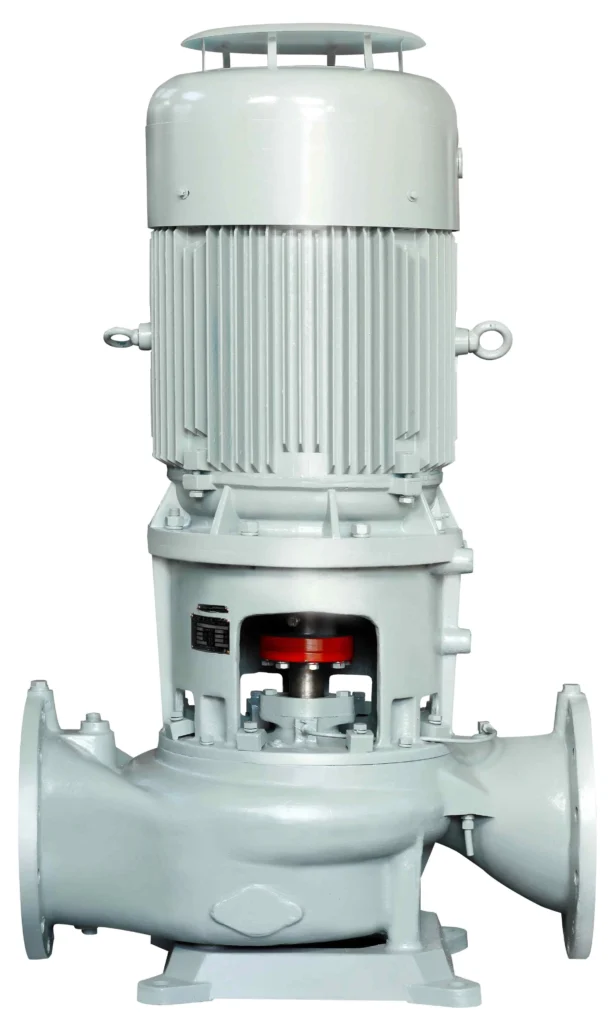
Sea-water pumps for filling, emptying and transferring ballast water on dredgers, general cargo ships and tankers. CTP supplies marine ballast pumps in vertical and horizontal arrangements, with corrosion-resistant sea-water materials and optional self-priming for suction-lift conditions. Tell us the vessel type and duty data — we recommend the matching pump model. Browse the full marine centrifugal pump range.
A marine ballast pump is a sea-water pump that fills and empties a vessel’s ballast tanks, controlling trim, stability and draft for loading, unloading and voyage conditions. Ballast duty is intermittent but demanding: the pump must handle sea water against a wide range of tank levels and heads, and on many vessels it must also prime itself when the tank level falls below the pump inlet.
According to the CTP Pumps marine centrifugal pump selection manual, the series recommended for ballast service covers flow rates up to 450 m³/h, heads up to 150 m, sea-water temperatures up to 80 °C, and suction sizes from DN 40 to DN 250 — operating speeds for both 50 Hz and 60 Hz power systems. Where flooded suction is not available, a self-priming arrangement (gas ejector or vacuum pump unit) is fitted. The full duty tables and technical documentation are available on our downloads page.
Ballast Pump Applications by Vessel Type
Ballast systems differ with the vessel’s trading pattern. Based on the pump arrangements listed in the CTP selection manual for three common vessel types:
Dredgers
On dredgers, the marine ballast pump adjusts trim while dredging and during transit. The same sea-water system often serves ballast, deck washing and jet services, so pumps are sized for the highest combined duty.
General cargo & multi-purpose ships
Ballast transfer supports cargo loading sequences across multiple holds. Ballast pumps here frequently double as bilge and general-service pumps, which is why self-priming capability is commonly specified.
Oil tankers
Ballast operations maintain hull stresses and propeller immersion between cargo voyages. Tanker ballast systems must comply with the IMO Ballast Water Management Convention, so pump selection is coordinated with the ballast water treatment system.
Recommended Pump Series for Ballast Duty
CTP does not ask you to pick a model — send the vessel type and duty data, and we recommend the arrangement. For ballast service the starting point is usually the EMC series marine centrifugal pump:
EMC vertical arrangement — small deck footprint in machinery spaces; rigid motor connection; upper pull-out design keeps overhaul time short at sea or in port.
Self-priming option — a gas ejector (E) or vacuum pump (N) unit allows the pump to prime when the ballast tank level drops below the pump inlet, a common condition during tank stripping.
Horizontal alternative — where deck area is free and flooded suction is available, CTP’s horizontal series (interchangeable parts with the EMC) can be matched to the same duty.
Ballast duty means permanent sea-water service, so wetted parts carry the sea-water material combination from the CTP selection manual:
Part
Ballast (sea-water) duty
Casing / casing cover
Tin bronze
Impeller / seal ring
Tin bronze
Shaft
Stainless steel
Mechanical seal faces
SiC / SiC
Packing
Carbon fibre
O-rings
NBR
Special material requirements can be specified at order. This sea-water combination is standard on every CTP marine ballast pump. Source: CTP Pumps marine centrifugal pump selection manual.
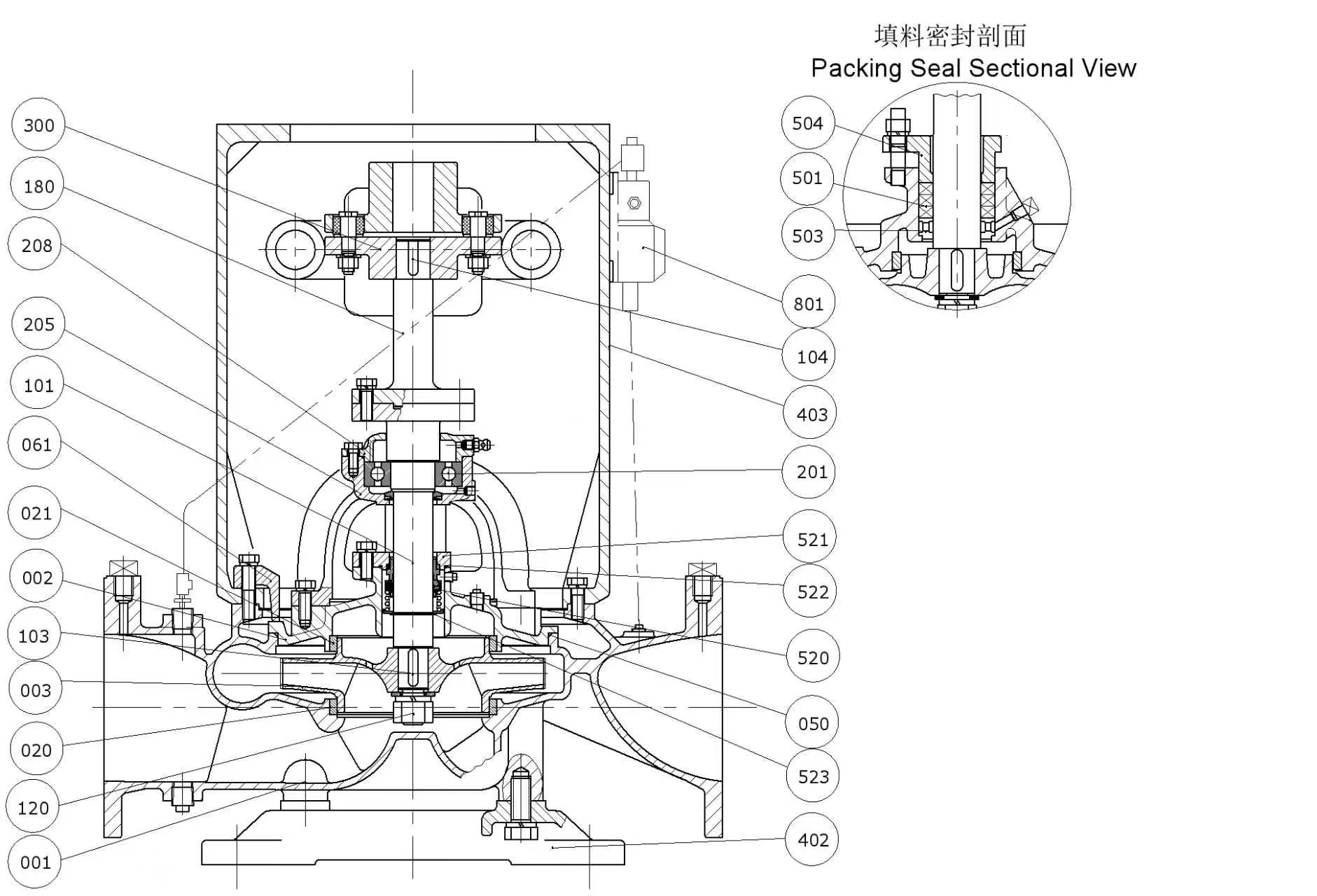
Sectional view of the recommended marine ballast pump — packing seal arrangement
Recommended Ballast Pump Parts List
Numbered parts of the sectional drawing above, with materials for sea-water ballast duty:
No.
Part
Material
001
Pump Casing
Bronze
002
Casing Cover
Bronze
003
Impeller
Bronze
020
Wear Ring
Bronze
021
Wear Ring
Bronze
050
O-Ring
NBR
061
Fixing Plate
Carbon Steel
101
Shaft
Stainless Steel
103
Impeller Key
Stainless Steel
104
Coupling Key
Carbon Steel
120
Impeller Nut
Stainless Steel
180
Spacer Shaft
Carbon Steel
201
Ball Bearing
Bearing Steel
No.
Part
Material
205
Bearing House
Cast Iron
208
Bearing Cover
Cast Iron
300
Coupling
Carbon Steel + Rubber
402
Pump Bed
Cast Iron
403
Frame
Cast Iron
501
Packing
Carbonized Fiber
503
Lantern Ring
Bronze
504
Packing Cover
Bronze
520
Mechanical Seal
Seal faces: SiC + SiC
521
Mechanical Seal Cover
Bronze
522
O-Ring
NBR
523
Retaining Ring
Stainless Steel
801
Self-priming Device
Gas ejector / vacuum pump unit
Materials shown for sea-water (S.W.) ballast duty. The pumps are available in other material combinations at request. Source: CTP Pumps.
How to Select a Ballast Pump
Marine ballast pump selection starts from the vessel’s ballast system design, not from a catalogue model. Provide the following and our engineers will recommend the pump, motor and sealing arrangement:
→ Required ballast flow and total head
→ Vessel type and tank arrangement
→ Suction conditions (flooded or lift — determines self-priming need)
→ Available NPSH at the pump inlet
→ Power supply (50/60 Hz) and motor standard
→ Classification society and flag state
Pay particular attention to NPSH: during tank stripping the available suction head falls, and cavitation risk rises. If you are unsure of the duty data, our pump selection assistance team will work through it with you.
Ballast systems are among the most regulated pump duties onboard. Reference points that commonly apply:
Ballast water management — the IMO Ballast Water Management Convention sets performance and documentation requirements; the pump must work together with the vessel’s treatment system.
Classification society rules — machinery and pump requirements are published by societies coordinated through IACS, for example DNV, Lloyd’s Register and CCS. Survey and certification can be arranged with the requested society.
Engineering practice — centrifugal pump design and acceptance commonly reference the ISO 5199 framework, with acceptance testing agreed between buyer and manufacturer.
Tell us the classification society and flag state at enquiry, and we will confirm the applicable certification route.
FAQ: Marine Ballast Pumps
What pump is used for ballast water?
Sea-water centrifugal pumps are the standard choice for ballast transfer. As a marine ballast pump, CTP recommends the vertical EMC-series arrangement where machinery-space deck area is limited, or horizontal arrangements where flooded suction and free floor area are available. The pump must be sized to the vessel’s ballast time requirement.
Does a ballast pump need to be self-priming?
Often yes. When the ballast tank level drops below the pump inlet during stripping, a standard centrifugal pump loses prime. CTP fits a gas ejector (E) or vacuum pump (N) self-priming unit for these duties; if the pump always sits below the lowest tank level with flooded suction, self-priming is not required.
Which materials are used for sea-water ballast service?
Tin bronze casing, casing cover, impeller and seal rings, with a stainless-steel shaft and SiC/SiC mechanical seal faces. Special materials can be specified at order.
How do I get a quotation for a ballast pump?
Send the vessel type, required flow and head, suction conditions, power supply and classification society. You do not need to choose a model — our engineers recommend the pump arrangement against your duty data. Use the contact button below or our pump selection assistance page.
Where can I download the full technical documentation?
Brochures, product flyers and O&M manuals for the CTP marine centrifugal pump range are available on our downloads page. If you need help matching documentation to your ballast duty, our selection assistance team will point you to the right data.
Ready to Discuss Your Marine Ballast Pump Duty?
Send the vessel type and operating data for your marine ballast pump — we will recommend the pump model, materials and certification route.
To provide the best experiences, we use technologies like cookies to store and/or access device information. Consenting to these technologies will allow us to process data such as browsing behavior or unique IDs on this site. Not consenting or withdrawing consent, may adversely affect certain features and functions.
Functional
Always active
The technical storage or access is strictly necessary for the legitimate purpose of enabling the use of a specific service explicitly requested by the subscriber or user, or for the sole purpose of carrying out the transmission of a communication over an electronic communications network.
Preferences
The technical storage or access is necessary for the legitimate purpose of storing preferences that are not requested by the subscriber or user.
Statistics
The technical storage or access that is used exclusively for statistical purposes.The technical storage or access that is used exclusively for anonymous statistical purposes. Without a subpoena, voluntary compliance on the part of your Internet Service Provider, or additional records from a third party, information stored or retrieved for this purpose alone cannot usually be used to identify you.
Marketing
The technical storage or access is required to create user profiles to send advertising, or to track the user on a website or across several websites for similar marketing purposes.